



- Home
- Sustainability
- Environment
- Pollution Prevention
Pollution Prevention
- Management of Chemical Substances
- Management of Air Pollutants
- Management of Water Pollutants
- Appropriate Disposal of Building Materials Containing Asbestos
- Storage and Proper Disposal of Polychlorinated Biphenyl Waste
- Management of Fluorocarbon Emissions
- Amount of Pesticide and Fertilizer Used in Forests
- Response to Soil Contamination Risks
- Project for Soil Purification Technology and Environmental Remediation Aided by Plants
Management of Chemical Substances
Hazardous chemical substances could have serious impact on human health and the environment and pose disaster risks. The Sumitomo Forestry Group has established a system to keep track of the amounts of hazardous chemical substances including volatile organic compounds (VOCs) used and emitted by the Group and manage these substances appropriately. We conduct regular measurements to ensure compliance with regulatory standards for various chemical substances as required by laws in each country. If these standards are not met, we investigate the causes and implement measures to reduce the amount to below the regulatory limit, thereby ensuring the proper management of hazardous chemical substances. In addition, from the perspective of reducing environmental impact, we promote initiatives to reduce the use and emission of hazardous chemical substances. Going forward, we will not only comply with relevant laws and regulations but also strive for continuous improvement.
Management of Chemical Substances at Domestic Manufacturing Plants
The Sumitomo Forestry Group manages hazardous chemical substances at three plants of Sumitomo Forestry Crest (Kashima, Niihama and Imari Plants) as well as at the Yotsukura Plant of Kowanomori and the Mombetsu Biomass Power Plant in accordance with the Act on the Assessment of Releases of Specified Chemical Substances in the Environment and the Promotion of Management Improvement (“PRTR Act") in Japan.
- Click here for related information
Management of Chemical Substances at Overseas Manufacturing Plants
At our overseas manufacturing plants, chemical substances, including those used in adhesives and coatings, are managed in accordance with the chemical substance management regulations enforced in each country, as detailed in the table below.
- Click here for related information
Management of Air Pollutants
Management of Air Pollutants at Domestic Manufacturing Plants and Power Generation Plants
The Sumitomo Forestry Group periodically measures the atmospheric emission concentration of dioxins, NOx, SOx, and soot and dust at Sumitomo Forestry Crest’s Kashima, Shizuoka and Niihama Plants, Sumitomo Forestry Landscaping’s Shinshiro Plant, and at the Mombetsu and Hachinohe Biomass Power Plants in accordance with the Air Pollution Control Act and relevant local regulations. In fiscal 2025, the measurement results were all within the relevant standard values.
- Click here for related information
Management of Air Pollutants at Overseas Manufacturing Plants
At its overseas manufacturing plants, the Sumitomo Forestry Group measures the atmospheric emission concentrations of NOx, SOx and soot and dust in Indonesia and Vietnam and also measures VOC emissions in the United States in accordance with the regulations of each country and region. In fiscal 2025, the measurement results were all within the relevant standard values.
- Click here for related information
Management of Water Pollutants
Management of Water Pollutants in Japan
Water pollutants could give direct damage to human health by being contained in drinking water and could also badly affect the habitats of living creatures in rivers, lakes and seas. The Sumitomo Forestry Group periodically conducts wastewater concentration tests at the Tsukuba Research Institute, all plants of Sumitomo Forestry Crest (Kashima, Shizuoka, Niihama and Imari Plants), and at the Mombetsu and Hachinohe Biomass Power Plants in accordance with the Water Pollution Prevention Act of Japan. As for the concentrations measured at the Kashima Plant, slags* already contained in the soil at the time of the purchase of the land (for the construction of the Kashima Plant) have caused the land to rise and the water quality (PH values) to exceed the regulated values. We have been continuing the measurement of the concentrations. For all other plants, the measured concentrations were all below the regulation thresholds.
At Sumitomo Forestry Crest’s Imari Plant, which is a “specified business site” under the revised Water Pollution Prevention Act of Japan, inspections are conducted by an external measurement agency once every two months. Also, daily water quality tests are internally carried out on wastewater from the in-house wastewater treatment facilities by using automatic COD measurement devices. The inspection results are reported to the local municipality every six months. In addition, water is sampled and inspected by the local prefectural government once a year. Through these inspections, we have confirmed compliance with the regulatory standards on wastewater.
The Tsukuba Research Institute is also a specified business site under the revised Water Pollution Prevention Act of Japan and informs Tsukuba City of the updating or new installation of related testing equipment. The Institute also entrusts monthly water quality inspection to an external measurement agency, monitor the results and makes a relevant report to Tsukuba City once every six months.
*General term for unwanted components that are separated during the smelting of minerals.
- Click here for related information
Management of Water Pollutants outside Japan
The Sumitomo Forestry Group conducts concentration tests of water pollutants at its overseas manufacturing plants in accordance with the water quality regulations for wastewater enforced in each country. Through the tests we have confirmed that all the plants meet the local regulatory standards for wastewater.
- Click here for related information
Appropriate Disposal of Building Materials Containing Asbestos
The Sumitomo Forestry Group has secured the proper disposal routes for asbestos. At Sumitomo Forestry, qualified employees conduct preliminary surveys on all construction works subject to the asbestos-related regulations to determine whether or not asbestos-containing building materials are present. In particular, the basis for determining the presence/absence of asbestos is made clear, and the results are reported to the asbestos preliminary survey results reporting system. At demolition sites, guidance is given and measures are implemented to prevent the release of asbestos into the air and to ensure that it is disposed of properly.
Also, for buildings of domestic Sumitomo Forestry Group companies, we are committed to properly treating asbestos based on the related law.
Our employees involved in demolition work as sales, design and production staff are provided with an e-learning opportunity to gain more knowledge about the preliminary survey of asbestos.
Storage and Proper Disposal of Polychlorinated Biphenyls Waste
We completed the treatment of polychlorinated biphenyls (PCBs) contained in equipment, such as end-of-life high-voltage capacitors, in Japan in fiscal 2021, in accordance with the Act on Special Measures concerning Promotion of Proper Treatment of PCB Wastes.
Management Status of Polychlorinated Biphenyl (PCB)*1
| Applicable Company | Applicable Facility | As of the End of fiscal 2024 | As of the End of fiscal 2025 | Management Status |
|---|---|---|---|---|
| ASTI | ASTI Plants | 65kg | 140.8kg | Electrical Boards |
*1The equipment included above is equipment currently in use or in storage which is being evaluated for processing
*2The (former) Nagoya Plant was closed in the end of June 2015
Management of Fluorocarbon Emissions
In April 2015, the Act on Rational Use and Proper Management of Fluorocarbons came into force for the purpose of promoting drastic measures over the entire lifecycle of fluorocarbons that have a strong greenhouse effect, from manufacture to disposal.
Since April 2020, regulations under the law have been further strengthened. In response, the Sumitomo Forestry Group has worked to raise employees’ awareness of these changes and take appropriate measures. At the same time, as a manager of Class 1 specified products, the Group carried out simplified and regular inspections as planned. Additionally, an inventory check is conducted once a year to confirm the number of managed units.
In most cases, the Sumitomo Forestry Group leases its offices as tenants in buildings and owns (or manages) commercial refrigeration and air-conditioning equipment (air-conditioners, refrigerators, etc.). Some of its business sites also have construction vehicles that fall under the category of "specified products," such as forklifts, etc. equipped with air conditioners. In response to the enforcement of the law, we are conducting periodic simple inspections of the equipment in which fluorocarbons are used as refrigerant as well as carrying out legal and periodic inspections on devices with compressors that have 7.5 kW or higher rated output.
Furthermore, when updating existing equipment or purchasing new equipment, we choose products in which fluorocarbons are not used in accordance with the Act on Promotion of Procurement of Eco-Friendly Goods and Services.
On the other hand, fluorocarbon gases used as refrigerant in testing equipment at the Tsukuba Research Institute and other sites and in air-conditioning and refrigeration units at affiliated companies are managed through fluorocarbon charging and recovery certificates in accordance with the Act. In fiscal 2024, the volume of fluorocarbon leakage was 22.0 t-CO2 for Sumitomo Forestry and zero t-CO2 for its affiliated companies. (Since the total is less than 1,000 t-CO2, it is not subject to the mandatory reporting of leakage volume.) We have confirmed that the leaked fluorocarbons were properly recovered, reprocessed and destroyed.
Sumitomo Forestry was awarded the highest rank of “A” in the 2025 Fluorocarbon Countermeasure Rating, a survey conducted by the Japan Refrigerants and Environment Conservation Organization (JRECO) targeting companies listed on the Tokyo Stock Exchange Prime Market. The survey evaluates companies' understanding, awareness, initiatives, and information disclosure related to the Act on Rational Use and Proper Management of Fluorocarbons.
*Data collection period: April 2024 to March 2025
- Click here for related information
Amount of Pesticide and Fertilizer Used in Forests
| FY2025 | ||
|---|---|---|
| Amount of Pesticide Used in Forests*1 | Herbicide*2 | 9,812kg |
| Bactericide | 202kg | |
| Insecticide | 584kg | |
| Fungicide | 472kg | |
| Amount of Fertilizer Used in Forests (nitrogen and phosphorous) *1 | Nitrogen fertilizer*3 | 4,785kg |
| Phosphorous fertilizer*3 | 6,150kg | |
*1Scope of tabulation: nursery fields in Japan and overseas forests (OBT, WSL, MTI, KMF, TPF)
*2Terbuthylazine, etc., are used mostly in New Zealand in accordance with FSC standards
*3All nursery fields. No spraying on forestland
Response to Soil Contamination Risks
Soil contamination is difficult to detect as contaminants build up and spread underground out of sight. The Sumitomo Forestry Group implements soil contamination countermeasures for the land owned or managed by the Group and conducts independent soil contamination surveys prior to new land purchases in the subdivision housing business. We implement appropriate measures for land in compliance with the Soil Contamination Countermeasures Act.
In the domestic built-for-sale housing business, the Sumitomo Forestry Group conducts independent surveys of land related to brownfields* and has not purchased or sold any land for which no soil contamination measures have been taken.
*Land that is not used or underutilized significantly compared to its potential value due to the presence or concern of soil contamination
Project for Soil Purification Technology and Environmental Remediation Aided by Plants
In reusing the site of an old factory and the like, issues tend to occur concerning the environmental impact associated with soil contamination and the cost of remedial measures as issues related to brownfields. Under the revised Fire Service Act of Japan, gasoline stations are now obliged to repair any underground tanks that have been laid under the ground for more than 40 years, and as a consequence of this, it is expected that between 1,000 and 2,000 stations will close down each year.
In order to meet the demand for environmental remediation measures including soil contamination countermeasures, the Sumitomo Forestry Group has been working on the remediation of contaminated soil by using the functions of plants (phytoremediation). As part of this, in fiscal 2012, in collaboration with ENEOS (JX Nippon Oil & Energy Corporation at the time), the Group developed a method for purifying soil contaminated with oil by using Burning Field, a variety of Japanese lawn-grass independently registered by the Group.
One of the functions provided by the variety of Japanese lawn-grass used in this soil purification method is that the nutrients transpiring from its roots activate microorganisms and help reduce the oil content in polluted soil inexpensively. Soil purification using this method has been completed at a total of five locations, such as former gasoline stations and oil depots, by fiscal 2025.
In fiscal 2013, we received commendation from the Ministry of the Environment for the soil purification method mentioned above, which was recognized as an exemplary environmental initiative by the Ministry. Also, in the surveys on low-cost, low-impact technologies for surveying and counteracting contaminated soil conducted by the Ministry in fiscal 2013 and fiscal 2014, it was recognized that the aforementioned variety of Japanese lawn-grass could revitalize oil-degrading microorganisms and might be useful for soil remediation at sites heavily contaminated with oil. Moreover, in October 2018, we received a Good Design Award for the soil purification method from the Japan Institute of Design Promotion. Subsequently in March 2020, the enhanced variety of Japanese lawn-grass “Burning Field” was registered with the Ministry of Land, Infrastructure, Transport and Tourism's New Technology Information System (NETIS). The Ministry implements this system to foster the sharing and provision of information for the effective use of new technologies. For NETIS-registered technologies, additional points are given in the overall evaluation of bids and in the construction performance evaluation that is conducted in the use stage of the technologies, which is expected to raise the awareness of contractors involved in public construction projects of the new technologies registered with NETIS and lead to the spread use of the technologies.
Going forward, by steadily achieving results in soil purification by using the method as mentioned above, we will continue to help resolve the nationwide problem of oil contamination.
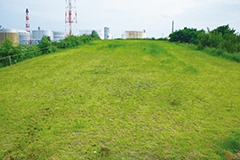
The grass variety laid on a former gasoline station site
- Home
- Sustainability
- Environment
- Pollution Prevention