



- Home
- Sustainability
- Social
- Human Rights
Human Rights Initiatives
Basic Policy
The Sumitomo Forestry Group signed the United Nations (UN) Global Compact in 2008. Subsequently, in July 2019, we formulated the Sumitomo Forestry Group Human Rights Policy with respect for the International Bill of Human Rights (Universal Declaration of Human Rights and International Covenants on Human Rights), the core labor standards of the International Labour Organization (ILO), and the United Nations (UN) Guiding Principles on Business and Human Rights. Then, in April 2023, in order to show the Sumitomo Forestry Group’s commitment to respecting human rights even more clearly, we revised the Sumitomo Forestry Group Human Rights Policy in reference to relevant international guidelines, such as the OECD Guidelines for Multinational Enterprises on Responsible Business Conduct. In the revised policy, we also describe our ideas about human rights-related cooperation with our business partners as well as about our support and expectations for their human rights-related initiatives. We also participate in the World Business Council for Sustainable Development (WBCSD) to grasp the trends of human rights-related initiatives that companies are expected to implement, as well as in the UN Global Compact and Global Compact Network Japan, including its Working Group on Human Rights Due Diligence (HRDD). Moreover, with the Sumitomo Forestry Group Code of Conduct, which is based on the above-mentioned international norms, we uphold the creation of “A respectful, healthy workplace.” To this end, the Code states that we shall respect the human rights of all individuals, including minorities and vulnerable people such as women, children, indigenous people ; shall not discriminate on the basis of race, ethnicity, nationality, gender, religion, ideology, disability, sexual orientation, gender identity or other; and shall not tolerate forced labor or child labor in any form.
The Group is also working to raise the awareness of its business partners about the details of its Human Rights Policy and Code of Conduct and is making an effort to fully grasp and mitigate human rights risks by implementing human rights due diligence and responding appropriately to human rights risks. We also give the maximum possible support where necessary to our business partners in their initiatives to respect human rights.
Sumitomo Forestry Group Human Rights Policy
The Sumitomo Forestry Group respects the human rights of all people involved in our Group's business operations and considers the respect for human rights a basic principle in all our activities. This thinking is rooted in Sumitomo's Business Spirit, which places prime importance on fairness and integrity for the good of society.
The Sumitomo Forestry Group Human Rights Policy (hereinafter, this Policy) has been formulated to further clarify the Group's thinking regarding the respect for human rights and to complement the Group's Corporate Philosophy, Our Value, Code of Conduct, Procurement Policy and others.
- A commitment to respect human rights
The Sumitomo Forestry Group respects human rights as defined by the Universal Declaration of Human Rights, the International Covenants on Human Rights (the International Covenant on Civil and Political Rights as well as the International Covenant on Economic, Societal and Cultural Rights), the International Labor Organization (ILO) Declaration on Fundamental Principles and Rights at Work, and other such international norms. The Group also complies with the United Nations' Guiding Principles on Business and Human Rights, the OECD Guidelines for Multinational Enterprises, and all relevant laws and regulations of each of the countries it conducts business in.
In countries and regions where there are discrepancies between domestic laws and international norms, the Group will respect and prioritize the undertaking of international norms. -
Scope of application
This Policy applies to all business operations of the Sumitomo Forestry Group. Furthermore, to widely apply the United Nations' Guiding Principles on Business and Human Rights, the Group asks business partners to be committed to the respect for all human rights based on an understanding of this Policy.
This Policy includes respect for the rights of workers of business partners, and when business partners or other related parties are associated with an adverse human rights impact, the Group will require those partners or other related parties to respect and not violate human rights in accordance with this Policy. -
Measures related to the respect for human rights
● Human rights due diligence
The Sumitomo Forestry Group has established a human rights due diligence system, has incorporated it as a necessary process of its business operations and applies it in an ongoing manner.
Human rights due diligence evaluates and identifies potential and actual human rights risks and takes measures to prevent or reduce those risks.
● Access to remedies
If a Sumitomo Forestry Group business operation has been found to have directly caused, contributed to or encouraged an adverse human rights impact, the Group shall undertake all necessary internal and external procedures and provide appropriate remedies.
Furthermore, the Group shall create necessary grievance mechanisms, maintain a reporting desk for internal and external access to remedies, and evaluate the effectiveness of corrective actions and remedies in an ongoing manner.
If a business partner has been found to be directly linked to an adverse human rights impact, the Group shall work with that partner to remedy the situation. Furthermore, the Group expects business partners to establish grievance mechanisms and engage in remediation. Where necessary, the Group will cooperate with judicial and non-judicial grievance mechanisms operated by national and public authorities.● Education
The Sumitomo Forestry Group shall provide periodic and appropriate training for directors, employees and other parties to ensure that the Human Rights Policy is integrated into all business operations of the Sumitomo Forestry Group.
The Group expects business partners to provide their workers with appropriate training on this Policy and will support their efforts when necessary.
● Rightsholder/Stakeholder engagement
In view of the seriousness of human rights violations, the Sumitomo Forestry Group shall engage in dialogue and consultation with rightsholders/stakeholders to identify potential or actual human rights risks, mitigation measures and remedies for actual incidents, as well as to monitor and evaluate its human rights efforts. The information and lessons learned will be incorporated into the human rights due diligence process.
● Information disclosure
To fulfill our reporting responsibilities, we shall disclose information and provide reports in a timely manner regarding initiatives based on this Policy and our response to potential or actual human rights issues.
Toshiro Mitsuyoshi
President and Representative Director
(Attachment)
Sumitomo Forestry Group Human Rights Salient Issues
The following are the Group's salient human rights issues as defined by international norms. These salient issues shall be updated as appropriate according to changes in the Group's business operations and societal conditions. The Group expects business partners to also make a commitment to respect human rights on all issues described here.
- 1.Human rights issues that must be respected from the perspective of international norms
<Prohibition of discrimination>
- Prohibition of discrimination based on gender, age, nationality, ethnicity, race, birthplace, religion, belief, disability, sexual orientation, gender identity or other
<Workers’ rights>
- Prohibition of child labor
- Prohibition of forced labor (including foreign and migrant workers)
- Prohibition of human trafficking
- Respect for the freedom of association and collective bargaining
- Prevention of excessive working hours (commitment to the ILO Hours of Work Convention)
- Prohibition of power and sexual harassment
- Occupational safety
- Prohibition of child labor
- Prohibition of forced labor (including foreign and migrant workers)
<Respect for the rights of vulnerable people related to our business operations>
- Respect for the rights of local residents in the areas we conduct business
- Respect for the rights of land, natural resources and indigenous peoples*1
- Respect for the rights of women*2
- Respect for the rights of children*3
- Respect for the rights of minority groups
- Respect for the rights of elderly people
- Respect for the rights of migrants and refugees*4
- Respect for the environmental rights of future generations (e.g., sustainable forest management)
- Respect for the right to have access to water and sanitation
- Respect for the rights of human rights defenders
*1Including respect for the rights described in the Voluntary Guidelines for Responsible Governance of Land Use, Fisheries and Forest Ownership in the Context of National Food Security (VGGT), IFC Performance Standards, ILO Indigenous and Tribal Peoples Convention 1998 (No. 169) or the UN Declaration on the Rights of Indigenous Peoples, etc.
*2Including a commitment to the Convention on the Elimination of All Forms of Discrimination against Women
*3Including a commitment to the Convention on the Rights of the Child
*4Including a commitment to the International Convention on the Protection of the Rights of All Migrant Workers and Members of Their Families
<Privacy, Freedom of expression>
- Respect for the privacy, protection and digital protection of personal information, including that of our customers and employees
- Respect for the right of freedom of expression
- 2.Issues identified through Human Rights Due Diligence
The Group recognizes the following human rights issues as salient and is working to mitigate risks identified through our human rights due diligence process.
- Respect for the rights of indigenous peoples and local communities
- Occupational health and safety
- Prevention of negative impacts on the health and safety of local communities
- Prohibition of forced labor and child labor
- Building effective remedial grievance mechanisms
(as of April 2025)
Implementation of Due Diligence and Response to Significant Human Rights Issues
Through human rights due diligence, the Sumitomo Forestry Group identifies factors that may have a negative impact on human rights and works to prevent or mitigate them.
Identifying Significant Human Rights Issues
In order to enhance our human rights due diligence measures, we have been conducting workshops on human rights due diligence to which we invite external experts as lecturers since 2017. In 2019, we created the Sumitomo Forestry Group Human Rights Impact Analysis Map and reviewed it in 2020 and 2025.
2019: Mapped risks to stakeholders in the value chain for each division, analyzed their impacts, and identified the importance and priority of human rights risks for each division
2020: Reviewed the map, regarding the impact of the spread of COVID-19 infections as a new risk factor
2025: Reviewed the map to specify existing and potential issues in light of the most recent business environment
The following shows the significant human rights issues identified by our Group and how they are related to each of our businesses.
Identified Significant Issues
| Human Rights Issues | Timber and Building Materials Business | Housing Business | Construction and Real Estate Business* | Environment and Resources Business | Lifestyle Services Business | ||
|---|---|---|---|---|---|---|---|
| Distribution | Manufacturing | Forestry | Energy | ||||
| Respect for the rights of indigenous peoples and local communities | |||||||
| Occupational Health and Safety | |||||||
| Prevention of negative impacts on the health and safety of local communities | |||||||
| Prohibition of forced labor and child labor | |||||||
| Building effective remedial grievance mechanisms | |||||||
*Overseas Housing Business and Real Estate Business
Response to Identified Issues
For identified issues, we take measures and corrective actions to reduce relevant risk factors for each business. In fiscal 2021, regarding “respect for the rights of indigenous peoples and local communities,” we reviewed the operational status of the grievance mechanisms in our overseas forestry business. Specifically, we checked the actual measures implemented under the mechanisms and identified the points to be corrected, with a focus on further reducing related risks and building better relationships with stakeholders in the areas where we develop our business. As a result of an online review conducted by a third-party organization, we verified that appropriate grievance mechanisms are in place at all of our three overseas tree planting sites in Indonesia, Papua New Guinea, and New Zealand. These systems allow for continuous consultation with local government agencies and communities. On the other hand, it has been revealed that further improvements need to be made to expand external information disclosure and incorporate the results of dialogue with rightsholders into the grievance mechanism.
In planning new businesses and projects, Sumitomo Forestry conducts risk assessments for the entire supply chain. Social aspects, such as human rights considerations for workers and other stakeholders, are also covered in the assessment.
Going forward, we will formulate measures and action plans to prevent, avoid, mitigate, and correct human rights risks for each stakeholder, and will conduct a PDCA cycle to improve the related initiatives.
- Click here for related information
Operation and Improvement of Grievance Mechanisms
Sumitomo Forestry recognizes the importance of having grievance mechanisms (complaint handling mechanisms) in place. Accordingly, our Customer Service Department serves as a point of contact that handles requests for consultations from customers and neighbors of our housing construction sites. We also have a compliance hotline, an external consultation service through the Employee Assistance Program (EAP) and a harassment hotline for business partners and employees. Moreover, we accept inquiries, including complaints, at our website in Japanese, English, and Chinese. Inquiries we receive through our website are forwarded by the contact point of the Corporate Communications Department to the relevant specialized department at the head office or to the responsible department for the appropriate treatment of the inquiry according to its details.
In October 2019, we put in place a whistleblowing mechanism shared by our overseas Group companies. For this system, we employed an external multilingual service operator to enable internal reporting in English, Chinese, Indonesian, Vietnamese, and Thai languages.
Moreover, in April 2026, we became a member of the Japan Center for Engagement and Remedy on Business and Human Rights (JaCER), with a view to providing a range of stakeholders, including Group employees, our business partners and people living in the neighborhood of our sites, with more convenient means to contact us. JaCER provides a platform for grievance redressal in line with the UN Guiding Principles on Business and Human Rights. JaCER operates the platform as an independent third party, and through it we accept complaints and reports about human rights violations from all stakeholders. The handling status of reports made through JaCER is disclosed on a grievance redressal list posted on JaCER’s website.
We will continue to improve our internal and external hotlines to prevent human rights violations and take necessary measures to remedy human rights violations should they occur.
- Click here for related information
Sumitomo Forestry Group Human Rights Impact Analysis Map
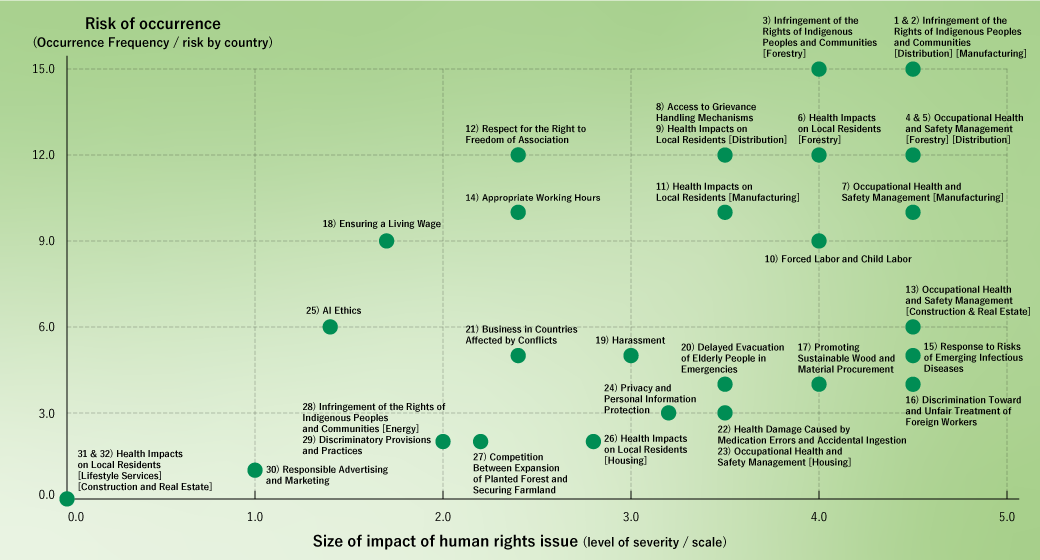
(Revised in April 2025)
Internal Sustainability Survey
Since fiscal 2012, the Sumitomo Forestry Group has been conducting an annual internal sustainability survey on the sustainability initiatives of each Group company, including their human rights-related measures. The survey results are reported to the Board of Directors via the Sustainability Committee, while improvements are made based on the results. In fiscal 2025, we surveyed the status of human rights training and the establishment of help desks for 71 Group companies (32 companies in Japan and 39 overseas). As a result, we have confirmed that company-wide human rights education and training, as well as internal rules and initiatives to address human rights violations, are either in place or planned. Also, as part of our efforts to prevent human rights violations in our value chain, we investigate the status of human rights-related communications and initiatives conducted by each Group company for their business partners and suppliers. According to the results of the survey conducted for fiscal 2025, there were no cases of human rights violations as defined in the Sumitomo Forestry Group Code of Conduct.
Sustainability Procurement Survey
The Sumitomo Forestry Group conducts fair and responsible procurement under the Sumitomo Forestry Group Procurement Policy, which obligates suppliers to protect human rights and workers’ basic rights as well as to prevent corruption. The procurement of imported wooden materials poses high human rights risks, so the Group checks these operations by conducting the Sustainability Procurement Survey on approximately 400 suppliers. Issues confirmed include violations of the rights of workers and local communities in the areas from which the products supplied to the Group and their raw materials are procured, as well as failures to give due consideration to the rights of local workers and communities in forest logging. Moreover, the Group engages in interviews and on-site surveys of suppliers for whom risk mitigation measures are deemed necessary in reference to the risk categories set for individual timber-producing countries. We also conduct the Sustainability Procurement Survey on both domestic and overseas suppliers of building materials and housing equipment.
- Click here for related information
Responding to UK Modern Slavery Act
Sumitomo Forestry established Sumitomo Forestry Europe Limited in the United Kingdom in 2022. Based on the Modern Slavery Act enacted in the country in 2015, the Group published a statement on its commitment to addressing risks related to modern slavery and human trafficking in its business operations and supply chains.
-
- Sumitomo Forestry Group Statement against Modern Slavery and Human Trafficking (Provisional translation) (2023)
- Sumitomo Forestry Group Statement against Modern Slavery and Human Trafficking (Provisional translation) (2024)
- Sumitomo Forestry Group Statement against Modern Slavery and Human Trafficking (Provisional translation) (2025)
Respect for Human Rights in the Overseas Forestry Business
The following shows the examples of initiatives implemented by the Sumitomo Forestry Group in its overseas forestry business as part of its stakeholder engagement and grievance mechanisms.
In many countries and regions, indigenous people and local communities are entitled to land rights by official laws and common laws. The forestry business can contribute to local employment and social development, for which building and maintaining good relationships with local stakeholders is essential, as well as to the protection of human rights and the sustainability of our own business.
Initiatives in Indonesia
In our forestry business in the province of West Kalimantan in Indonesia, we conducted a survey jointly with International Finance Corporation (IFC), a member of the World Bank Group in 2012. Specifically in the survey, we examined whether or not the land use plan for our business site was appropriately implemented and whether or not we were giving due consideration to the lives of local residents in line with the policy of protecting the rights of indigenous people and their cultural heritages.
In 2013, we shared the outcome of the aforementioned survey at a stakeholder meeting to which we invited local community members, neighboring businesses, experts in relevant fields, NGOs, and government officials. At another such meeting in 2015, we helped stakeholders strengthen their understanding of our business and environmental measures prior to the logging of planted trees. In these ways, we have been conducting our forestry business with consideration for human rights.
In 2018, with the help of IFC, we established a grievance mechanism to collect opinions of local residents, either in writing or through regular visits, and give our replies to them within seven business days. In 2025, PT. Wana Subur Lestari (WSL) and PT. Mayangkara Tanaman Industri (MTI) received a total of 11 comments and requests through the mechanism and replied to all of them.
Initiatives in Papua New Guinea
Also, we have installed a suggestion box at Open Bay Timber Ltd. (OBT) in Papua New Guinea. Anyone from the local area can submit their comments, regardless of whether they are a member of the company or not. In 2025, several submissions were made to the box, including applications for participation in the cacao business and requests for road repairs. We have carefully examined the details and provided responses as appropriate. Through the suggestion box, we also accept requests for consultation not only from our employees but also from local residents. The existence of a mechanism that allows local residents to express their opinions also helps increase their trust in the company.
Initiatives in New Zealand
Tasman Pine Forests Ltd. (TPF) in New Zealand keeps a stakeholder registry in which they register the records of important communications made with local residents, partner companies and other stakeholders (e.g., communication at meetings with a local environmental organization and at meetings on our operation plan held with local residents). Communicating with local stakeholders based on an understanding of the background information recorded in the registry helps us to build favorable relationships with stakeholders.
Human Rights Training
The Sumitomo Forestry Group provides lectures about human rights in its new employee training in Japan. We also require all Group employees with access to the intranet to attend the “Work and Human Rights” e-learning seminar every year (which they complete by scoring 80 points in the test). This seminar promotes respect for human rights and helps create a workplace free from discrimination. This training seminar is also intended to enhance participants’ awareness and understanding about people with disabilities, foreign nationals, members of the LGBTQ community, and other minorities. In fiscal 2025, 14,411 employees (6,422 Sumitomo Forestry employees and 7,989 employees of its Group companies) attended the seminar. Sumitomo Forestry also incorporates training on human rights in its courses for newly appointed leaders. We will continue our efforts to raise employees’ human rights awareness via e-learning and training opportunities.
Initiatives in the United States
In the United States, federal and state laws prohibit any employment discrimination for reasons such as race, gender, religion, birthplace, or health condition. In the country, local Sumitomo Forestry Group companies strive to share Sumitomo Forestry’s policy and philosophy on the provision of fair opportunities and the prohibition of discrimination by describing them in the employee handbook and through other means.
Prevention of Harassment
Sumitomo Forestry clarifies its policy on sexual harassment, workplace bullying, and maternity harassment by prohibiting such behavior and setting disciplinary standards against them in its employment regulations as a work rule to be observed by employees. The Sumitomo Forestry Group Code of Conduct also prohibits all forms of harassment. This fact is communicated via the internal website, employee handbook and handouts, as well as through various group training sessions and e-learning programs on harassment. Furthermore, our Personnel Department sends an email to every employee twice a year which calls for the elimination of all forms of harassment.
Since fiscal 2000, we have been operating a harassment hotline within the Personnel Department to deal with requests for consultations about harassment appropriately. In fiscal 2025, we reviewed two cases that had been reported to the harassment hotline.
All of our domestic and overseas Group companies also take various measures against harassment, such as establishing a consultation hotline on workplace harassment and discrimination.
Sumitomo Forestry includes seminars on harassment in its training for newly appointed leaders, and also provides managers who have subordinates with training on psychological safety. We are raising employees’ harassment awareness through seminars on the basic knowledge of harassment and preventive measures, making use of the e-learning opportunities available to Group companies.
- Click here for related information
- Home
- Sustainability
- Social
- Human Rights