



- Home
- Sustainability
- Sumitomo Forestry Group's Sustainability Management
- Stakeholder Engagement
Stakeholder Engagement
Basic Policy
The Sumitomo Forestry Group is interacting with various stakeholders because the Group is conducting activities in a broad range of global businesses, from the upstream to the downstream sections, with wood—as a renewable natural resource—at the core. We attribute importance to conducting business activities in consideration of the direct and indirect relationships with our stakeholders. Our focus is always on communication with the stakeholders and we will sincerely respond to their expectations and requirements.
Stakeholders of the Sumitomo Forestry Group
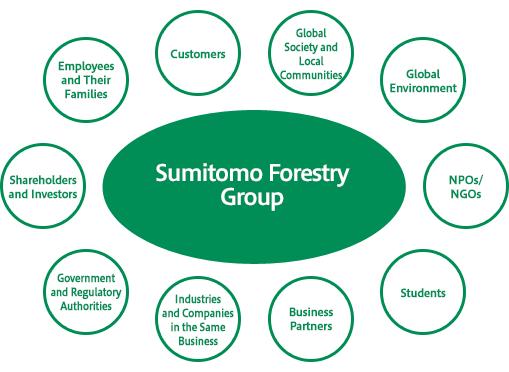
Responsibilities and Communication Methods
Customers
Customer needs are diversifying as the social environment changes dramatically due to energy issues resulting from frequent large-scale disasters and global warming in addition to the decreasing population and aging society of Japan, centralization to urban areas and depopulation in other areas, as well as a growing mindset toward health.
The Sumitomo Forestry Group conducts comprehensive efforts toward safety and quality issues in light of these circumstances to not only reduce risks but also to create new business opportunities by responding to societal and environmental changes with a view to further increasing customer satisfaction.
| Responsibilities | Communication Methods |
|---|---|
|
|
- Click here for related information
Employees and Their Families
A wide range of themes have been raised concerning social challenges related to employment and labor, including respecting human rights, providing an equal workplace without discrimination, and ensuring safety on-site. Also, considerations toward work-life balance and the reduction of long working hours are deemed important.
We believe that working to resolve these issues provides a driving force to improve our corporate value and promote our business by bringing positive effects including gaining talent, increasing the motivation of employees, and eliminating risks for employees.
| Responsibilities | Communication Methods |
|---|---|
|
|
- Click here for related information
Shareholders and Investors
In recent years, institutional investors have reviewed their way to evaluate companies, attributing importance to engagement*. Accordingly, the frequency of dialogue between companies and their shareholders/investors has been increasing. Through the dialogue, companies explain their corporate strategies and initiatives to enhance their corporate value to the shareholders/investors.
Trends to promote even broader engagement are growing also in Japan after the establishment of Japan’s Stewardship Code.
The Sumitomo Forestry Group places great importance on engagement from the perspectives of properly assessing the corporate value and earning trust from the market. The Group discloses a wide range of information, including non-financial information, in a timely and transparent manner to facilitate understanding among stakeholders of its management policies and business strategies, while regularly escalating the opinions and requirements of its important stakeholders, such as investors, to the management for reflection in its measures towards sustainable growth.
*Constructive dialogue held between companies and investors toward value creation
| Responsibilities | Communication Methods |
|---|---|
|
|
- Click here for related information
Government and Regulatory Authorities
As a company involved in a variety of businesses centered upon wood, the Sumitomo Forestry Group needs to adhere to laws and regulations by continually updating information about relevant laws and regulations in each region and country where it engages in business activities.
For example, in the field of housing construction, we must comply with the Building Standards Act as well as a wide range of other laws and regulations. In addition, for forest management, we need to submit various notifications to the government and regulatory authorities because we conduct projects related to national land in the forestry business.
We strive to earn greater trust from society by thoroughly complying with various laws and regulations as well as ensuring proper communication with the government and regulatory authorities in each country where our businesses are expanding.
| Responsibilities | Communication Methods |
|---|---|
|
|
Industries and Companies in the Same Business
The Sumitomo Forestry Group believes a fair, open competitive environment is essential to foster sustainable growth throughout the entire industry in which it conducts business.
Also, industry associations and other organizations are indispensable in creating relevant rules. Based on this recognition, we participate in industry associations and other organizations to contribute to the growth and development of the industry by taking a leading role as a front runner in the industry.
| Responsibilities | Communication Methods |
|---|---|
|
|
Business Partners
Promoting sustainable forest management and procuring wood from sustainable forests are extremely important requirements that the Sumitomo Forestry Group should meet to ensure its business continuity and development. We need to meet these requirements also to deal with the risk elements that include laws and various regulations enforced in each country related to illegal logging.
With its business partners, the Sumitomo Forestry Group will make efforts to promote the preservation and development of forest resources, plant more trees, and make proactive use of forest-certified timber for the effective use of limited global resources, thereby enhancing its business foundation.
| Responsibilities | Communication Methods |
|---|---|
|
|
- Click here for related information
Students
The Sumitomo Forestry Group provides students, who are the next generation of leaders, with information on its philosophy, business models that contribute to economy, society and the environment through its core business, various initiatives implemented by the Group such as those for workstyle reforms, and its medium- to long-term vision.
In addition to helping them deepen their understanding of Sumitomo Forestry, we are actively engaging in two-way communication with them by using online tools in a rapidly changing environment.
| Responsibilities | Communication Methods |
|---|---|
|
|
- Click here for related information
NPOs/NGOs
The Sumitomo Forestry Group addresses social issues, such as deforestation, loss of biodiversity, and human rights issues in collaboration with NPOs and NGOs that have specialized knowledge and understand the situation in the regions where the Group operates. We expect that cooperation with civil society will lead us to produce even greater results to meet the local challenges faced by each community, with Sumitomo Forestry and many other people fulfilling their respective roles.
| Responsibilities | Communication Methods |
|---|---|
|
|
- Click here for related information
Global Environment
The Sumitomo Forestry Group attributes importance to the global environment, on which its business activities have both direct and indirect impacts. Accordingly, the Group established its Environmental Philosophy in December 1994 and the Group-wide Environmental Policies in October 2000.
We also formulated our first medium-term environmental management plan (FY2010-FY2014) in fiscal 2009. We subsequently established the medium-term CSR management plan (FY2015-FY2020) that included environmental targets in fiscal 2014. Furthermore, in 2022, we set our long-term vision “Mission TREEING 2030” and also formulated the Mid-term Sustainability Targets incorporating our sustainability strategies and priority issues. We are steadily raising the level of our environmentally conscious activities, with each of our Group companies and departments implementing a PDCA cycle for the achievement of their respective annual targets.
| Responsibilities | Communication Methods |
|---|---|
|
|
Global Society and Local Communities
The Sumitomo Forestry Group recognizes the importance of contributing to the growth of local communities as well as protecting the local forest resources when starting and expanding businesses.
Based on this recognition, we work to build an infrastructure for smooth operations and business expansion in each country and region by engaging in local social contribution activities and activities that focus on dialogue and cooperation with local communities.
| Responsibilities | Communication Methods |
|---|---|
|
|
- Click here for related information
Recommendations on Public Policies
The Sumitomo Forestry Group coordinates and cooperates with national and local governments, the business community and others, and makes recommendations toward the improvement and resolution of worsening environmental and social issues.
Positions in Major Related Associations (as of December 31, 2025)
| Organization | Position |
|---|---|
| Council for the Promotion of Decentralization Reform, Cabinet Office | Chairperson |
| Japan Association of Corporate Executives | Secretary |
| Organization for Landscape and Urban Green Infrastructure | Chairperson (Representative Director) |
| Keidanren (Japan Business Federation) | Standing Secretary |
| Keidanren Nature Conservation Council | Vice-chairperson |
| Japan Federation of Housing Organizations | Vice-chairperson (Representative Director) |
| Wooden Home Builders Association of Japan | Chairperson (Representative Director) |
| The Machinami Foundation | Director |
| Japan International Association for the Industry of Urban Development, Building and Housing | Chairperson (Representative Director) |
| The Provision of Quality Housing Stock Association | Vice-chairperson |
| Japan Wood Design Association | Vice-chairperson & Representative Director |
| Japan-China Association for Building and Housing Industry | Vice-chairperson (Director) |
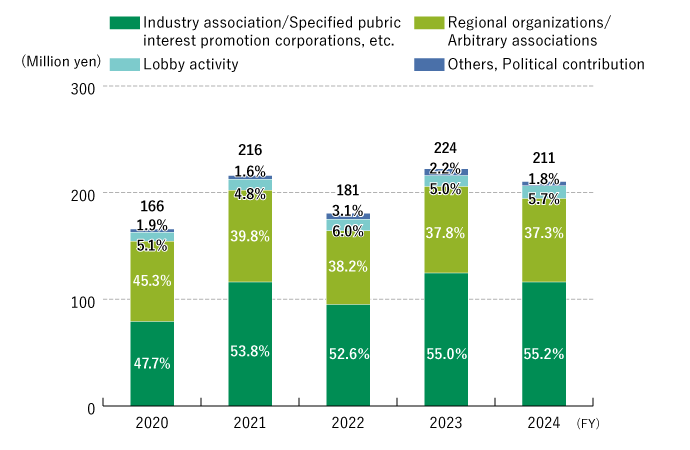
Costs Related to Various Associations
- Home
- Sustainability
- Sumitomo Forestry Group's Sustainability Management
- Stakeholder Engagement