


- Home
- Sustainability
- Environment
- Sustainable Forest Management
- Sustainable Forest Management by the Sumitomo Forestry Group
Sustainable Forest Management by the Sumitomo Forestry Group
Overview of the Forests Managed and Owned by the Sumitomo Forestry Group
-
Forest Managed Area:
Approximately
374,000 hectares -
Forest Certified Area:
Approximately
316,000 hectares
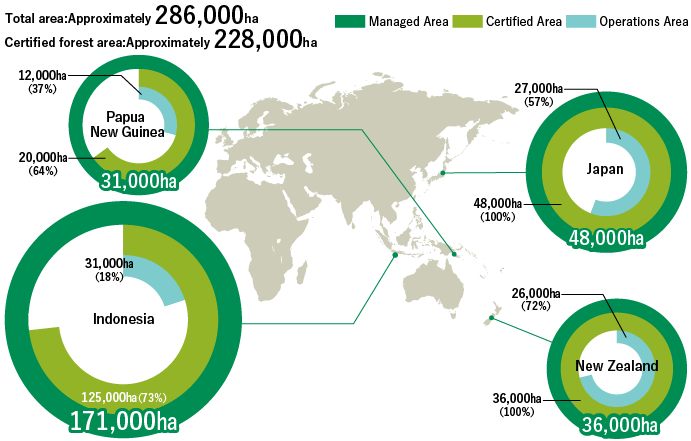
Forest Managed Area, Forest Certified Area and Production Forest Area in FY2025
Basic Policy
In addition to supply function of producing wood, forests have diverse public benefits such as water source recharge, prevention of landslides, CO2 absorption and storage as a countermeasure to global warming, preservation of biodiversity, and recreation.
The Sumitomo Forestry Group's businesses that handle timber resources are closely connected with forests. We advance sustainable forest management both in Japan and overseas to ensure that wood resources will be available in perpetuity while preserving the public benefits of forests. In addition, we are promoting acquisition of forest management certification in Japan and overseas in each business of upstream forest management, midstream timber distribution and manufacturing, and downstream wooden construction.
In our domestic forestry business, we will pursue profitability through wood production in Company-owned forests, while at the same time practicing sustainable forest management that ensures legality and takes biodiversity and local culture into consideration, and obtain and maintain 100%*1 forest certification in forests subject to certification.
As for the overseas forestry acquisition, below are the guiding principles for selection when obtaining new forests areas.
- Forests areas that have good relationships with surrounding villages and local communities.
- Forest areas where HCVA*2, HCSA*3 and FPIC*4 can be implemented, environmental risks can be eliminated, and no environmental problems were identified in the past.
- Forest areas with third-party forest certification (FSC®-FM is preferable and FSC-CW and PEFC certification are acceptable as well).
*1Except for land leased to Kawanokita Development and surrounding forests
*2High Conservation Value Assessment: inspection and assessment to establish conservation policies for areas specified as having high conservation value, such as rare flora and fauna habitat
*3High Carbon Stock Assessment: inspection and assessment to specify and restrict development in areas with high carbon absorption volumes so that the volume of carbon retained by forests does not decline when forest land is converted to other uses
*4Free Prior Informed Consent: Prior sharing of information and consensus formation with indigenous people and others in cases where there is likelihood that operations could impact the lands, territories or resources of indigenous people
- Click here for related information
Forest Management and Wood Usage
Sustainable Forest Management
Seedling Cultivation and Planting
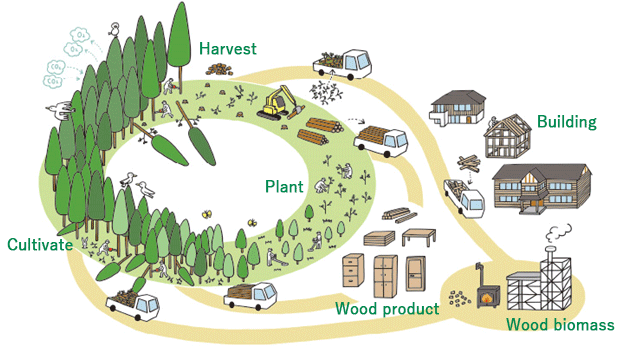
Securing superior seedlings is a crucial first step toward sustainable forest management. Stable production of superior seedlings leads to appropriate forestation. Sumitomo Forestry was the first to modernize container seedling production. We are contributing to the sustainability of forest resources and active resource production through facility-based seedling production under appropriate environmental management. In Japan, we have six seedling production facilities to produce 2 million seedlings per year and supply them to our own forests as well as to national forests and privately-owned forests throughout Japan. Overseas, in Indonesia and Papua New Guinea, we produce our own seedlings for planting. Also, in New Zealand and every other region where we do business, we are managing forests in a sustainable manner by repeating the cycle of planting, growing and harvesting trees.
Cultivation
The Sumitomo Forestry Group owns and manages approximately 48,000 hectares of forests in Japan and approximately 231,000 hectares of forests overseas. We strive to maintain and improve the forests’ public benefits by implementing appropriate management for the growth of trees in these forests throughout the process including planting trees, clearing underbrush, pruning, and thinning.
Consideration for Biodiversity
The Sumitomo Forestry Group protects the following forest areas as conservation forests based on the results of high conservation value (HCV) assessments and other forest surveys and evaluations that it has conducted: areas that have great impact on biodiversity, areas that are of particular importance in terms of biodiversity, areas adjacent to these areas, and areas not suitable for forestry.
Based on the results of the HCV assessments and other forest surveys and evaluations that we had conducted at 23 sites (with a total area of 279,040 hectares), we managed 22 sites (with a total area of 98,761 hectares) as conservation forests in fiscal 2025. In the total areas, we do not include social forest and non-operating forest areas.
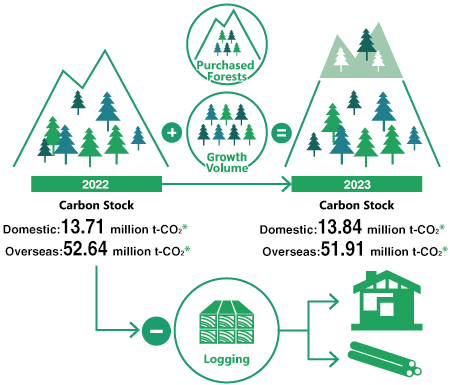
Carbon stocks* of the forests owned by the Sumitomo Forestry Group in Japan at the end of fiscal 2025 were 14.19 million t-CO2 (up 140,000 t-CO2 from the previous fiscal year’s level). Carbon stocks of the Group’s overseas planted forests were 51.15 million t-CO2 (down 370,000 t-CO2 year on year).
*Formula to Calculate Carbon Stock
Stem volume per hectare of forest × biomass expansion factor × (1 + ratio of underground area to aboveground area) × volume density × carbon content ×CO2 conversion factor
Parameters such as Stem volume and expansion factor are based on own plot data for domestic forests, WSL, and MTI, while OBT and TPF refer to standard values of each country, etc. For protected forests in overseas forests, carbon stock is assumed to be zero for non-forested and low accumulation areas such as rivers, lakes, roads, etc., and degraded forests in WSLs and MTI
Carbon Stock of Forests in Japan and Overseas
Logging and Usage
The Sumitomo Forestry Group logged approximately 168.17 hectares of trees (including thinning) in Japan and approximately 5,725 hectares of trees overseas in fiscal 2025 in forests it owns or manages based on the long-term logging plans. Harvested wood is milled and processed before finally reaching the market as products such as housing materials and furniture. In the case of wood turned into structural materials for housing, the products are used for several decades. Even after being dismantled or at the end of their product life, wooden buildings and timber and wood products can be reused as fiberboards or other building materials or as a raw material for making paper, and all that time they will continue to retain the absorbed CO2. The amount of CO2 released when wood is ultimately burned as a wood fuel is equivalent to the amount absorbed from the atmosphere as trees grow, and therefore it does not represent an increase in atmospheric CO2 over the life cycle of the tree.
Reforestation
Harvesting and using wood alone will lead to a diminishing of forest resources that will be used to produce wood products. The Sumitomo Forestry Group therefore promotes sustainable forest management by always planting new trees after logging.
In fiscal 2025, we planted trees on 110.8 hectares of land in Japan, and on 6,156 hectares of land overseas. The newly planted trees will absorb CO2 in their growth and retain it as carbon.
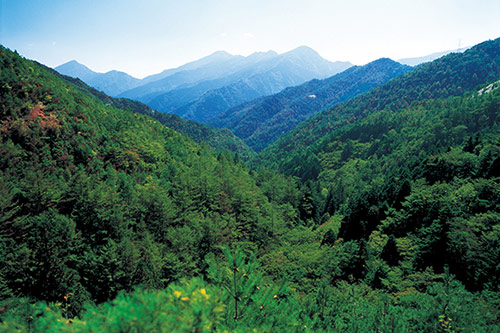
Forest owned by Sumitomo Forestry in Shikoku
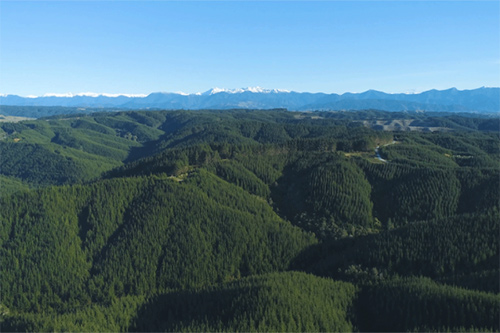
Planted forest in New Zealand
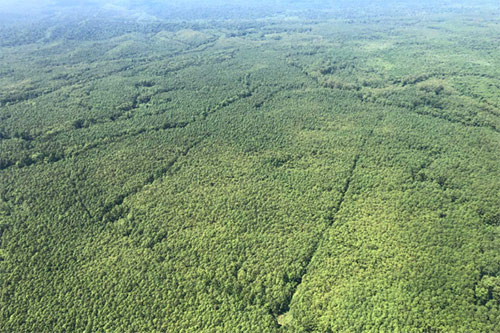
Planted forest in Papua New Guinea
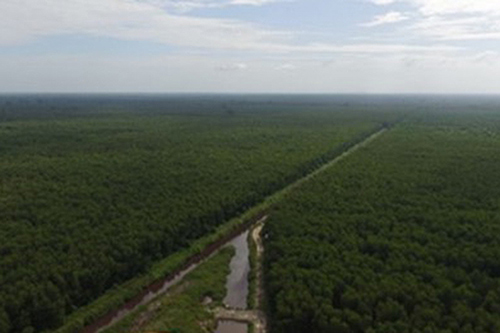
Planted forest in Indonesia
Area of Forest Managed and Owned by the Sumitomo Forestry Group
By Company: Company-Owned Forests and Overseas Plantations/Forest Management and Ownership Areas, etc.
| Japan | Managed Area (ha) |
Certified Area (ha) |
Production Forest Area (ha) |
Forest certification system*1 [Certification Number] |
Certification Issuing Body | Afforestation Area for Social Forestry*3 (ha) |
|
|---|---|---|---|---|---|---|---|
| Sumitomo Forestry | 48,050 | 47,982 | 27,285 | SGEC[JAFTA-010] | Japan Forest Technology Association (JAFTA) | - |
| Indonesia | Managed Area (ha) |
Certified Area (ha) |
Production Forest Area (ha) |
Forest certification system*1 [Certification Number] |
Certification Issuing Body | Afforestation Area for Social Forestry*3 (ha) |
|
|---|---|---|---|---|---|---|---|
| MTI | 70,584 | 70,584 | 10,563 | PHL*2[EQC‑PHL‑015] | PT Equality Certification | - | |
| WSL | 40,751 | 40,751 | 11,545 | PHL*2[10‑PHL‑024] | PT Almasentra Sertifikasi | - | |
| KMF | 9,270 | 9,270 | 5,440 | PHL*2[IMS‑SPHL‑009] | PT Inti Multima Sertifikasi | - | |
| JLA | 29,794 | 0 | 0 | - | - | ||
| BIOS | 9,738 | 9,738 | 0 | PHL*2[IMS‑SPHL‑026] | PT Inti Multima Sertifikasi | - | |
| KTI | 3,800 | 0 | 3,800 | - | 7,295 | ||
| KAM KTI | - | - | - | - | 1,005*4 | ||
| KBM KTI | - | - | - | - | 1,330*5 | ||
| Total | 163,996 | 120,605 | 41,612 | - | 9,630 | ||
| Vietnam | Managed Area (ha) |
Certified Area (ha) |
Production Forest Area (ha) |
Forest certification system*1 [Certification Number] |
Certification Issuing Body | Afforestation Area for Social Forestry*3 (ha) |
|
|---|---|---|---|---|---|---|---|
| VECO | 0 | 0 | 0 | - | 1,323 | ||
| Papua New Guinea | Managed Area (ha) |
Certified Area (ha) |
Production Forest Area (ha) |
Forest certification system*1 [Certification Number] |
Certification Issuing Body | Afforestation Area for Social Forestry*3 (ha) |
|
|---|---|---|---|---|---|---|---|
| OBT | 31,260 | 12,993 | 11,618 | FSC®[NC-FM/COC-005600] | Preferred by Nature | - | |
| 6,495 | CFM(Controlled Forest Management) | Preferred by Nature |
| New Zealand | Managed Area (ha) |
Certified Area (ha) |
Production Forest Area (ha) |
Forest certification system*1 [Certification Number] |
Certification Issuing Body | Afforestation Area for Social Forestry*3 (ha) |
|
|---|---|---|---|---|---|---|---|
| TPF | 35,665 | 35,665 | 27,637 | FSC®[SCS-FM/COC-400042] | SCS | - |
| Managed Area (ha) |
Certified Area (ha) |
Production Forest Area (ha) |
|
|---|---|---|---|
| Total | 278,971 | 223,740 | 108,152 |
*MTI: Mayangkara Tanaman Industri, WSL: Wana Subur Lestari, KMF: Kubu Mulia Forestry, JLA: Jelai Lestari Abadi, BIOS: Bina Ovivipari Semesta, KTI: Kutai Timber Indonesia, KAM KTI: Koperasi Serba Usaha Alas Mandiri, KBM KTI: Koperasi Bromo Mandiri, RPI: Rimba Partikel Indonesia, VECO: Vina Eco Board, OBT: Papua New Guinea Open Bay Timber, TPF: Tasman Pine Forests
*1Forest Management (FM) certification authenticates sustainable forest management by having a third-party carry out inspections based on objective indicators with focus on: (1) compliance with laws and system frameworks, (2) forest ecosystem and biodiversity maintenance and conservation, (3) respect for rights of indigenous people and local communities, (4) maintenance and enhancement of forest productivity
*2Pengelolaan Hutan Lestari (PHL) is an Indonesian certification of sustainable forest maintenance. JLA plans to obtain PHL certification prior to the start of harvesting
*3Area of planted forest was calculated using the actual number of seedlings distributed and the number of seedlings planted per hectare (The number of trees planted per hectare is planned annually for each tree species)
*4[Forest certification system] FSC® [Certification number] SA-FM/COC-002083 [Certification body] Soil Association
*5[Forest certification system] FSC® [Certification number] SA-FM/COC-005493 [Certification body] Soil Association
- Click here for related information
Area Managed by the Forestry Fund
As of End of December, 2025
| Fund Name | Managed Area (ha) | Certified Area (ha) | Forest Certification Systems |
|---|---|---|---|
| Eastwood Climate Smart Forestry Fund I*1 | Approximately 94,000*2 | Approximately 92,000*2 | FSC, SFI, etc. |
*1Forest asset areas/United States, Canada, Panama, Costa Rica
*2Converted from acres
Other Managed Area
As of End of December, 2025
| Managed Area (ha) | Certified Area (ha) | Forest Certification Systems | |
|---|---|---|---|
| Japan Forest Asset Co., Ltd | 751 | 0 | - |
*Reference: Area of Planted Forests in Australia (as of February 2024): 957 hectares
- Home
- Sustainability
- Environment
- Sustainable Forest Management
- Sustainable Forest Management by the Sumitomo Forestry Group