



- Home
- Sustainability
- Governance
- Return to Shareholders and IR Activities
Return to Shareholders and IR Activities
Basic Policy
In recent years, institutional investors have reviewed their way to evaluate companies, attributing importance to engagement. Accordingly, the frequency of dialogue between companies and their shareholders/investors has been increasing. Through the dialogue, companies explain their corporate strategies and initiatives to enhance their corporate value to the shareholders/investors. Trends to promote even broader engagement are growing also in Japan after the establishment of Japan’s Stewardship Code.
The Sumitomo Forestry Group places great importance on engagement from the perspectives of properly assessing the corporate value and earning trust from the market. The Group discloses a wide range of information, including non-financial information, in a timely and transparent manner to facilitate understanding among stakeholders of its management policies and business strategies, while regularly escalating the opinions and requirements of its important stakeholders, such as investors, to the management for reflection in its measures towards sustainable growth.
Returns to Shareholders
Basic Policy on Returns to Shareholders and Retained Earnings
Sumitomo Forestry regards it as one of its priorities to return profits to its shareholders. By making use of the retained earnings for effective investments and R&D activities to increase our corporate value on a long-term basis, we will work to improve our return on equity (ROE) and increase our shareholder equity, while returning profits to shareholders at an appropriate level in consideration of our profitmaking status, business foundation, financial status, cash flow balance and other factors.
In our medium-term management plan “Mission TREEING 2030 Phase 2” (for 2025 to 2027), we set the policy of keeping our dividend payout ratio at 30% or more of the profit attributable to shareholders of the parent company as our basic policy on returns to shareholders. Based on this policy, we will return profits to shareholders in proportion to the profits gained, setting the lower limit of 50 yen on the amount of our annual dividend per share.
*After the execution of a stock split
Payment of Dividends in the Fiscal Year Ended December 31, 2025
In the fiscal year ended December 31, 2025, we paid the year-end dividend of 28 yen per share.
On July 1, 2025, we implemented a 3-for-1 stock split for common stocks. On June 30, 2025, we paid the interim dividend of 75 yen per share, which is equivalent to 25 yen per share after the execution of the stock split. Accordingly, we paid an annual dividend of 53 yen per share in total for the fiscal year ended December 31, 2025.
Share Distribution by Shareholder Type (As of December 31, 2025)
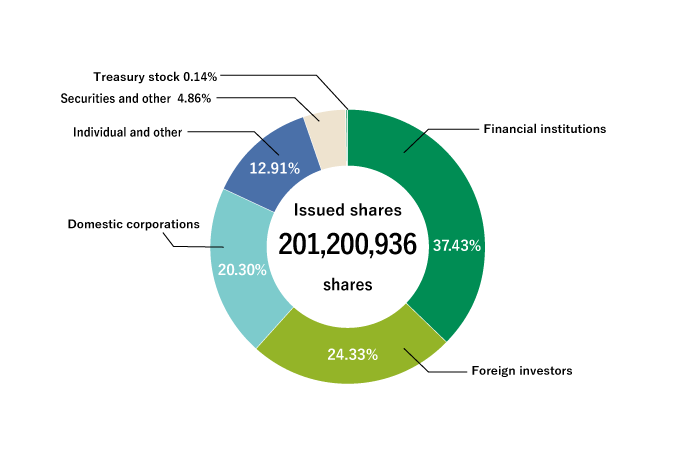
*For share distribution, figures are rounded down to the second decimal place.
*On July 1, 2025, Sumitomo Forestry implemented a 3-for-1 stock split for common stocks.
Information Disclosure and Communication
Basic Policy on Information Disclosure and Communication
For greater management transparency, Sumitomo Forestry takes a proactive approach to information disclosure.
We strive to provide reporting and explanations in an easy-to-understand manner at the General Meeting of Shareholders. We also publish various IR information in Japanese and English on our website including financial information such as short financial statements, fact book and a summary of financial results and forecasts, as well as housing business information such as monthly order reports. In addition, we also publish detailed information about sustainability initiatives in Japanese and English on our website.
Furthermore, through news releases, we share the latest information about Sumitomo Forestry Group with stakeholders. Sumitomo Forestry published 90 news releases in fiscal 2025.
We have been publishing the Integrated Report since fiscal 2017 in order to strengthen our communication on the Group’s initiatives to improve corporate value from both financial aspect and sustainability-related non-financial aspect. Besides the integrated report and the Japanese language report for shareholders on business activities, we also strive to actively provide information, including the notifications for our Ordinary General Meeting of Shareholders in both English and Japanese in print and online forms.
- Click here for related information
Integrated Report 2025
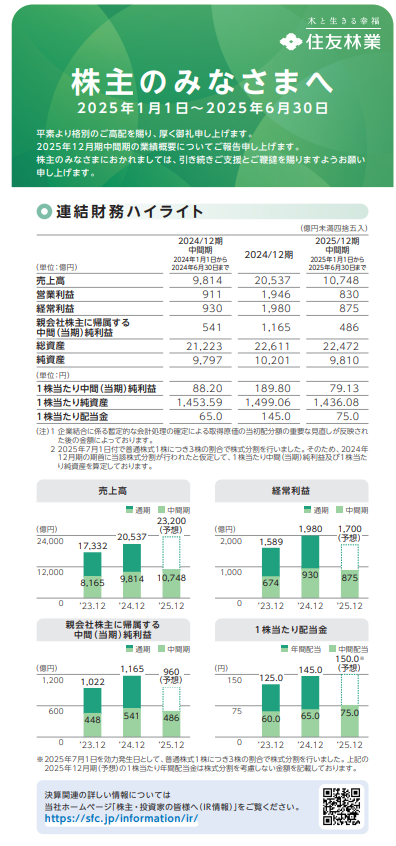
Reports on business activities published for shareholders in the second quarter (in Japanese)
Two-Way Communication with Shareholders and Investors
- Click here for related information
General Meeting of Shareholders
Through various initiatives, we endeavor to get as many shareholders as possible to participate in the meetings and exercise their right to vote. These initiatives include sending out and posting online convocation notices (in Japanese and English) earlier than legally required deadline and accommodating shareholders who wish to cast their votes electronically (online, etc.).
Individual Meetings
Sumitomo Forestry holds individual meetings with security analysts and institutional investors following the announcement of its quarterly results. In fiscal 2025, we held a total of 662 meetings in Japan and overseas. In addition, we held an on-site tour in the housing business in the United States, a briefing session on our housing business in Japan, and an on-site briefing session on a wooden rental apartment. We will continue to hold small meetings and on-site briefings going forward.
IR Informative Meetings for Individual Investors
Sumitomo Forestry holds regular IR informative meetings for individual investors. In September and November 2025, we held a total of two IR informative meetings for individual investors online. During these meetings, we explained about the Sumitomo Forestry Group’s history and business lines, in addition to our long-term vision and medium-term management plan. The meetings were concluded with a Q&A session.
IR Activities for Overseas Institutional Investors and Shareholders
We held online conferences with institutional investors and shareholders in the United States, Europe, Asia, and other regions in fiscal 2025, in addition to engaging in efforts such as distributing the English versions of financial information to all of our institutional investors and shareholders overseas. In Europe, we held an overseas roadshow to explain our business performance and business strategies, and exchanged ideas with participants.
We also participated in domestic and international conferences held by stock brokerage firms to have even more opportunities to have dialogue with investors.
Initiatives for Sustainable Finance
Conclusion of a Positive Impact Financing Agreement
In December 2024, Sumitomo Forestry entered into a loan agreement under a syndicated*1 Positive Impact Finance arrangement (a type of business loan that does not specify the use of funds), with Sumitomo Mitsui Trust Bank, Limited serving as arranger. This agreement was concluded based on a "Positive Impact Assessment" in accordance with the United Nations Environmental Programme Finance Initiative*2 Principles for Positive Impact Finance*3 and the "Model Framework for Financial Products for Corporates with unspecified use of funds." Sumitomo Forestry has received the financing in recognition of its contribution to the SDGs through its wood-centered value chain, the "Wood Cycle.” In concluding this agreement, Sumitomo Forestry obtained a third-party opinion*4 from Japan Credit Rating Agency, Ltd. regarding the alignment with the Principles for Positive Impact Finance and the model framework, as well as the validity of the assessment indicators used.
Through this agreement, Sumitomo Forestry also aims to improve its medium-to long-term corporate value by further enhancing initiatives to achieve the SDGs.
*1A financing method in which multiple financial institutions form a syndicate to provide loans under a single agreement and on the same terms
*2UNEP FI established the Principles for Positive Impact Finance in January 2017. Companies disclose their contributions toward achieving the SDGs and banking institutions evaluate the positive impact and provide capital in an effort to maximize the positive impact and minimize the negative impact of corporate entities. The banking institutions providing the financing take responsibility to monitor the indicators and verify ongoing positive impact. The United Nations Environment Programme (UNEP) is a subsidiary body of the United Nations established in 1972 as an implementing agency for the Declaration of the United Nations Conference on the Human Environment and the International Environment Action Programme. UNEP FI is a broad and close partnership between UNEP and more than 200 global financial institutions. Since its establishment in 1992, it has been working with financial institutions, policies, and regulators to transform itself into a financial system that integrates economic development with environmental, social and governance (ESG) considerations
*3This is a financial framework for achieving the Sustainable Development Goals (SDGs) formulated by the United Nations Environment Programme Finance Initiative (UNEP FI) in January 2017. By disclosing contributions to the achievement of SDGs, with banks assessing the positive impact of these contributions and providing funds, the framework guides the efforts of fund providers to increase positive impacts and reduce negative impacts. As the responsible financial institution, lending banks monitor indicators to ensure that their impacts are continuing.
*4For details on the third-party opinion, please refer to related information
- Click here for related information
Conclusion of a Sustainability Linked Loan Agreement
In August 2022, we concluded a sustainability linked loan agreement with Sumitomo Mitsui Banking Corporation. Sustainability linked loans incentivize borrowers to achieve the sustainability performance targets ("SPTs") set based on the borrower's management strategy, and promote environmentally and socially sustainable economic growth by aligning borrowing terms with actual progress of SPTs. By aiming to achieve the SPTs set in the loan agreement, we will promote sustainable management.
For the SPTs in this loan agreement, we have adopted the CDP Climate Change Score, which is administered by CDP, an international NGO, to evaluate the greenhouse gas emission reduction activities and climate change mitigation measures.
In 2025, one similar financing agreement was concluded. We will continue to actively exchange information with financial institutions.
- Home
- Sustainability
- Governance
- Return to Shareholders and IR Activities