



- Home
- Sustainability
- Environment
- Analysis Based on TNFD’s LEAP Approach
Analysis Based on TNFD’s LEAP Approach
- Impacts of Nature-related Issues on the Sumitomo Forestry Group (Analysis based on TNFD's LEAP Approach)
- Identification of Priority Sites (“Locate”)
- Evaluation of Priority Sites (“Evaluate”)
- Quantitative Analysis of Environmental Impacts (Estimates Using LIME)
- Main Risks and Opportunities Identified (“Assess”)
- Analysis of Financial Impacts
- Sumitomo Forestry's Measures (“Prepare”)
Impacts of Nature-related Issues on the Sumitomo Forestry Group (Analysis based on TNFD's LEAP Approach)
From the end of 2023 to 2024, we organized a working group consisting of members from the headquarters and business divisions to conduct an analysis using the LEAP approach* regarding our dependency/impact on nature as well as nature-related risks and opportunities posed to us. The findings of this working group were compiled in March 2024. The tools used in each phase of the LEAP approach are all those recommended by TNFD.
*LEAP approach is an integrated approach developed by the TNFD for businesses to assess nature-related issues such as their interfaces with nature and nature-related dependencies, impacts, risks and opportunities. The approach consists of the following four phases: locate, evaluate, assess and prepare.
Relationship between Sumitomo Forestry's business and nature (examples)
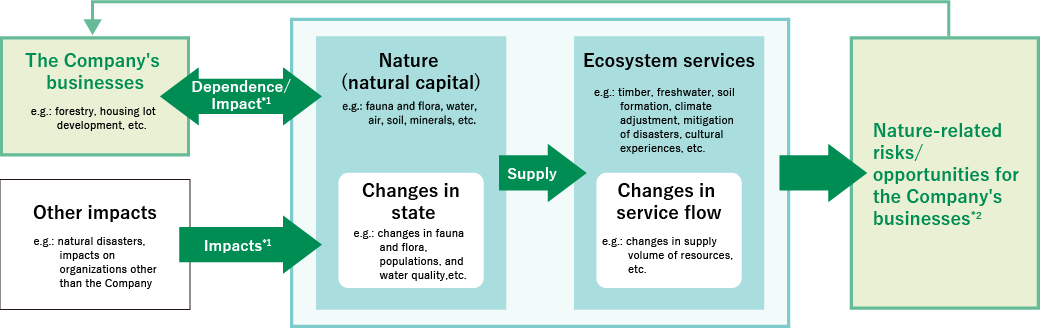
*1Negative impacts: temporary soil degradation due to development activities
Positive impacts: enhancement of forest ecosystem services through proper management
*2Risks: landslides in planted forests
Opportunities: monetization opportunities for ecosystem services, addition of value to wood products
- Click here for related information
Identification of Priority Sites (“Locate”)
In the "Locate" phase, we took a bird's-eye view of the Sumitomo Forestry Group's supply chain, examining its interfaces with nature at each business site and identifying the sites that should be prioritized for relevant measures.
First, we selected 148 business sites for evaluation evenly from the five businesses that are considered to have particularly large interfaces with nature (timber and building materials, housing, overseas housing, real estate, and environment and resources). For each of the five businesses, we selected the sites from among our direct operation locations and those in the upstream and downstream sections of the supply chain.
| Business segment | Business | Upstream | Direct operations | Downstream | |||
|---|---|---|---|---|---|---|---|
| Scope and data source | Number of business sites subject to analysis | Scope and data source | Number of business sites subject to analysis | Scope and data source | Number of business sites subject to analysis | ||
| Timber and Building Materials | Manufacturing | Supplier list | 4 | Company's own manufacturing plants | 12 | Buyers: not subject to analysis because, like in the Housing Business, a majority consists of other companies | ‒ |
| Distribution | Supplier list | 4 | Not subject to analysis | ‒ | Buyers: not subject to analysis | ‒ | |
| Housing Business | Custom-built detached houses and subdivision houses | Supplier list | 4 | Subdivision housing areas where we own a large number of housing lots | 8 | Use: Not subject to analysis
Waste: Landfills where we dispose of large amounts of waste |
10 |
| Renovation | Same as above | ‒ | Business sites with orders of 100 million yen or more | 5 | Use: Not subject to analysis
Waste: Same as above |
‒ | |
| Greening | Supplier list for materials | 8 | Green spaces with large areas of environmental greening | 20 | Use: Not subject to analysis
Waste: Same as above |
‒ | |
| Overseas Housing Business and
Real Estate Business |
Custom-built detached houses and subdivisions | Supplier list for construction materials | 6 | Custom-built detached houses and subdivision areas in the United States (16 states) and Australia (5 states) | 29 | Use: Not subject to analysis
Waste: Final disposal outside of scope |
‒ |
| FITP | Supplier list | 2 | Panels plant | 5 | Use: Same as above | ‒ | |
| Real estate development | Supplier list for construction materials | 1 | Development business in Indonesia and Thailand | 2 | Use: Not subject to analysis
Waste: Final disposal outside of scope |
‒ | |
| Environment and Resources Business | Company-owned forests | Uses supplier list for the timber building materials business | ‒ | Company-owned forests in Japan (Hyuga, Mombetsu, Niihama) | 14 | Use: Not subject to analysis because sales are to the Company's own timber building materials business | ‒ |
| Overseas forest management | ‒ | Overseas forest management (New Zealand, Papua New Guinea, and Indonesia) | 5 | Use: Main buyers | 2 | ||
| Biomass power generation | ‒ | Biomass power generation plant | 6 | Waste: Main business partners | 1 | ||
| Total 29 | Total 106 | Total 13 | |||||
Next, we evaluated the 148 sites by making combined use of their location information gained through geographic information systems (GIS) and other tools, and ecosystem information obtained by using nature-related risk analysis tools such as ENCORE*1. As a result, we narrowed down the list of the sites to those that are financially significant or located in ecologically sensitive areas.
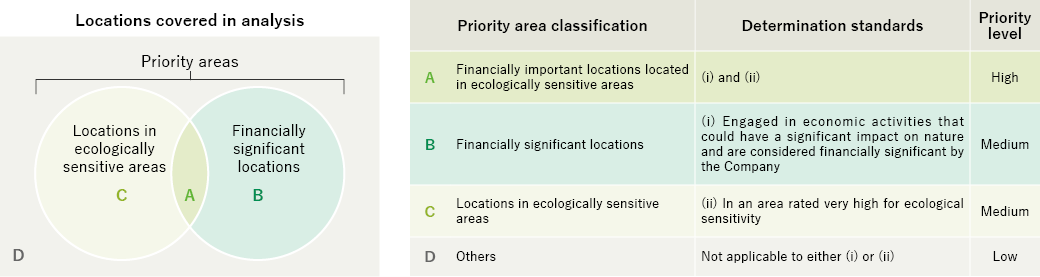
We selected financially significant sites (B in the following figure titled "Classification of Priority Areas") based on actual situations and on the following criteria: rating for one or more of the evaluation items is “Very high” in ENCORE; the site accounts for 10% or more of total sales or total transaction value in the business; and the site cannot be substituted within one year in the event of an emergency.
For sites located in ecologically sensitive areas (C in "Classification of Priority Areas"), we assessed the sensitivity of the ecosystem in which each site is located by using ENCORE, IBAT*2 and the like to conduct evaluation concerning five requirements ([1] significance of biodiversity, [2] high integrity of the ecosystem, [3] rapid decline in ecosystem integrity, [4] significance of providing ecosystem services and [5] physical water risk) on a five-point scale [1-5]. Then we selected the sites with an average score of 4 or higher for the five requirements.
*1ENCORE: Exploring Natural Capital Opportunities, Risks and Exposure. It is a nature-related risk analysis tool developed by the Natural Capital Finance Alliance, which is an international financial industry organization in the natural capital sector, and others
*2IBAT: Integrated Biodiversity Assessment Tool. It was developed by the World Conservation Monitoring Centre of the United Nations Environment Programme and others by integrating biodiversity information globally.
Classification of Priority Areas
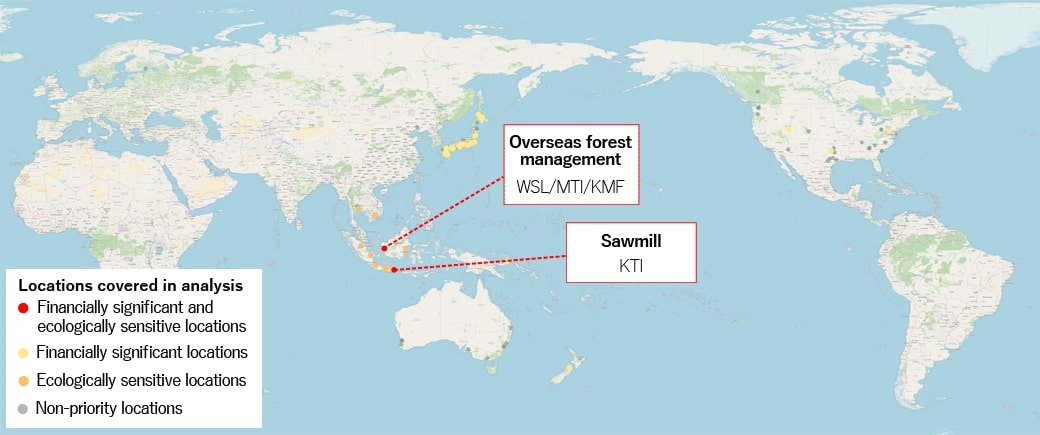
As a result, we identified 37 sites that need to be prioritized (“priority locations”). In addition, as priority locations considered financially significant and located in ecologically sensitive areas (A in "Classification of Priority Areas"), we selected two locations. One is PT. Wana Subur Lestari (WSL), PT, Mayangkara Tanaman Industri (MTI), PT. Kubu Mulia Forestri (KMF) of Indonesia (forest management companies) and the other is Kutai Timber Indonesia (KTI) (manufacturer).
Scores for identified priority locations and the sensitivity of the ecosystem in which each is located
| Importance of biodiversity | Ecosystem integrity (high integrity) | Ecosystem integrity (rapid decline) | Importance of providing ecosystem services | Physical water risks | Total assessment | |
|---|---|---|---|---|---|---|
| WSL/MTI/KMF | 4 | 5 | 5 | 3 | 5 | 4.4 |
| KTI | 4 | 3 | 5 | 3 | 5 | 4.0 |
Analysis tools used as an assessment criterion for ecologically sensitive areas
| Requirements for ecologically sensitive areas | Overview | Tools used in the assessment*1 | |
|---|---|---|---|
| (1) Biodiversity Importance | Areas of biodiversity importance (protected areas, areas of scientific importance, areas with endangered species, etc.) | World Database on Protected Area (WDPA): Comprehensive database of protected areas on land and in the ocean around the world Key Biodiversity Area (KBA): Areas scientifically recognized as having biodiversity importance IUCN Red List of Threatened Species: A list of endangered species from around the world |
|
| Ecosystem Integrity | (2) High Integrity*2 | Areas of high ecosystem integrity (the degree to which ecosystem composition, structure, and function are within natural variability) | Biodiversity Intactness Index: an index of ecological integrity from 0 to 1 for sites around the world IUCN Red List of Ecosystem database: a geographic compilation of trends in ecosystem collapse risk by integrating data on ecosystem area and ecosystem integrity |
| (3) Rapid Decline※2 | Areas where rapid loss of ecosystem integrity is reducing the resilience of ecosystem service provision | Biodiversity Intactness Index: an index of ecosystem integrity that uses changes in ecosystem integrity to assess changes over time by country (see above for indicators) | |
| (4) Ecosystem Service Delivery Importance*2 | Areas where ecosystem service provision is important, including indigenous communities and local communities | ENCORE: a map showing hotspots of natural capital decline and depletion by location that are important for the provision of ecosystem services LANDMARK: a platform for information on land ownership by indigenous peoples and local residents at various locations around the world. |
|
| (5) Water Physical Risk | Areas of high physical water risk, including water use restrictions, flooding, and poor water quality | Aqueduct: a comprehensive water risk score calculated by combining 13 water risk indicators, including water quantity, water quality, and reputational risk at each business site | |
*1Comprehensive assessment criteria were extracted from the tools described in the TNFD LEAP Guidance based on the availability of data, natural capital to be evaluated, and other factors
*2For (2) high integrity and (4) significance of providing ecosystem services, a 50 km buffer was established around the location to determine overlap with the data set for assessment. Regarding (3) rapid decline, the year 2000, when our overseas forest management and administration were in full operation, was used as the base year, and the year 2023 was used as the comparison year
*The table above was compiled based on Guidance on the identification and assessment of nature-related issues: The LEAP approach v1.0
*Company-owned forests covering large areas were analyzed by establishing centroids and 30-50 km buffers for each geographic mass, with individual centroids for enclaves not included in the buffers, and integrating the results in favor of higher-risk results
- Click here for related information
Evaluation of Priority Sites (“Evaluate”)
In the “Evaluate” phase, we assessed the dependency and impact of the Group's operations on nature at 37 priority locations. Based on the ENCORE results gained in the “Locate” phase and on the regional characteristics identified by using analytical tools such as Aqueduct and IBAT, we qualitatively assessed the dependency and impact of each priority location. For impact, we assessed both positive and negative impacts by utilizing analytical tools as well as our own expertise accumulated through business. The major assessment results are shown below.
Regarding Access and Benefit-Sharing (ABS), there were no particular regions of concern related to genetic resources held by indigenous peoples or local communities; however, considering the extensive areas required for forest and timber resources, ABS remains an important issue, and we will continue to make efforts to build relationships going forward.
| Business segment | Dependence | Positive impact | Negative impact |
|---|---|---|---|
| Timber and Building Materials Business | Timber supply service driven by forest ecosystems Soil maintenance and flood prevention services |
(Not applicable because it mainly involves production activities) | Alteration of surrounding forests and soil degradation associated with raw wood procurement Water quality pollution of surrounding water bodies from wastewater discharged by manufacturing plants |
| Housing Business,
Overseas Housing Business, and Real Estate Business |
Soil maintenance and landslide prevention services | Maintain and improve ecosystem services (rainwater recharge, water purification, habitat provision) by enhancing natural symbiotic functions within housing and construction sites (greening, water retention/permeable pavement, biodiversity initiatives, etc.) | Waste discharge, water resource use, and invasion of alien species associated with subdivision development |
| Environment and Resources Business | Surface water and soil provision service driven by forest ecosystems Raw material supply service for power generation fuel (wood, PKS※, coal) Surface water supply service for steam turbine-based power generation |
Maintain and improve ecosystem services (carbon storage, water cycle, disaster prevention, habitat provision) through sustainable forest and peatland management Supporting sustainable forest management in the region by driving demand for wood resources through the use of wood chips in power generation |
Impact on the livelihoods of communities dependent on forests Fragmentation of habitats for flora and fauna due to tree felling Waste discharge and water/air pollution caused by power generation facilities |
*PKS: Palm Kernel Shell
Quantitative Analysis of Environmental Impacts (Estimates Using LIME)
In order to quantitatively assess the environmental impacts of our business activities on nature, we are promoting life cycle assessment (LCA) using LIME3.*1
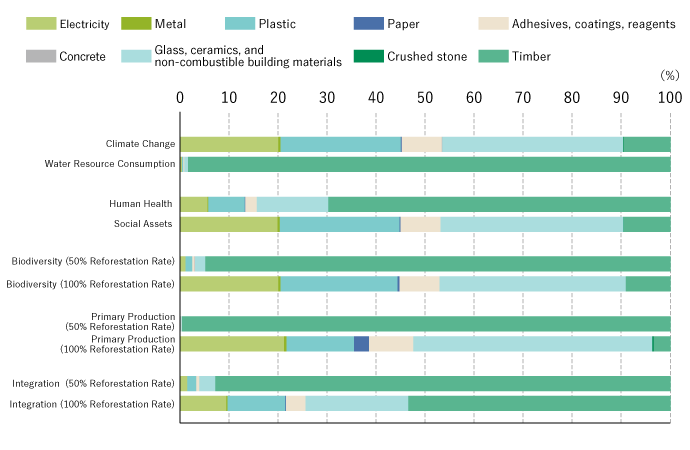
In 2025, we attempted a quantitative evaluation using LIME3 for raw materials in the upstream section of the value chain and for electricity and fuel mainly used in manufacturing operations, focusing on the Sumitomo Forestry Group’s material balance analysis results.
LIME3 quantifies human health damage, social asset depletion due to resource consumption, and biodiversity loss measured by species extinction probability, and the disruption of primary production in trees to use them as indicators.
Regarding biodiversity loss and primary production in trees, assuming a 50% reforestation rate after forest harvesting, timber accounts for the majority of the impact. The integrated results of all the indicators reaffirmed that timber has a significant impact. On the other hand, it was also confirmed that the loss of biodiversity and the impact on primary production in trees decrease when the reforestation rate is estimated at 100%. We will continue to promote sustainable timber procurement and aim to grasp its quantitative impacts by using life cycle assessment methods such as LIME.
LIME3 currently provides coefficients only at the national level. Also, the impacts related to land-use change and maintenance through afforestation in timber production are still under investigation, and average values by region are used. Therefore, we recognize the need to continue improving the analysis method going forward.
Sumitomo Forestry is participating in the Development and Demonstration Project of Nature Footprint Based on the Promotion of Nature-related Information Disclosure by Financial/Investment Institutions and International Standardization (Cabinet Office BRIDGE*2), and we are proceeding with estimations using LIME. In this project, the development of biodiversity and ecosystem service footprints is planned at a more detailed regional level than the national level, and we also intend to conduct evaluations focusing on the upstream section of the value chain in our timber business.
*1LIME3: Life Cycle Impact Assessment Method Based on Endpoint Modeling 3. It was developed in Japan as a life cycle impact assessment method. LIME3 utilizes the latest knowledge and analytical techniques from natural and social sciences. It is applied not only in LCA but also in various fields, such as environmental efficiency, environmental accounting, and full cost assessments.
*2Cabinet Office BRIDGE is a set of programs that leverage the leadership function of the Council for Science, Technology and Innovation (CSTI) of the Cabinet Office of the Japanese government to promote and accelerate the implementation of policies by various ministries and agencies in areas in which public-private R&D investment is expected to increase. It aims to bridge innovative technologies and outcomes generated through initiatives such as the Strategic Innovation Promotion Program (SIP) and other governmental R&D measures for solving societal issues, creating new businesses, and ultimately realizing Japan’s future vision (Society 5.0).
Impact Assessment of Our Entire Business Using LIME3
- Click here for related information
Main Risks and Opportunities Identified (“Assess”)
In the “Assess” phase, we identified business risks and opportunities arising from the dependency and impacts on nature as determined in the “Evaluate” phase. We then conducted qualitative assessment to identify the major risks and opportunities. First, we made risk/opportunity analysis for 25 sites, which were selected evenly from priority locations to avoid bias toward specific businesses. Based on what had already been addressed at the sites, we qualitatively evaluated the priority level of remaining risks and potential opportunities.
For remaining risks, we qualitatively evaluated their priority level based on the criteria of "degree of impact" for financial impact on the business and "probability of occurrence" based on past cases and existing initiatives. For potential opportunities, we qualitatively prioritized them in terms of an increase in market size* by 2030 (“business attractiveness") and on our advantage in capturing such opportunities (“the Company’s strengths”).
| Size of impact | Probability of occurrence | ||
|---|---|---|---|
| Definition | Financial impacts in business (sales of business sites and replaceability) |
Presence of examples of similar incidents occurring in the past and existing initiatives | |
| Standard | Large | Impacts amounting to 10% or more of the division’s sales | No existing initiatives implemented in the past |
| Medium | Less than 10%, but difficult to replace within a year/ More than 10% but can be replaced within a year |
Occurred in the past but there are existing initiatives in place/ Has not occurred in the past and there are no existing initiatives |
|
| Small | Can be replaced within a year | Has not occurred in the past and there are existing initiatives | |
| Attractiveness of business | The Company’s strengths | ||
|---|---|---|---|
| Definition | Amount of increase* in market value by 2030 | The Company’s competitiveness in acquiring opportunities | |
| Standard | Large | 30 trillion yen or higher | Has relevant resources and existing initiatives |
| Medium | 5 to 30 trillion yen | Has relevant resources but no existing initiatives/ Does not have relevant resources but has existing initiatives |
|
| Small | Up to 5 trillion yen | ||
*Estimated based on Identifying Biodiversity Threats and Seizing Business Opportunities published by AlphaBeta in July 2020 and New Nature Economy Report II: The Future of Nature and Business published by the World Economic Forum in July 2020
| Division*1 | Business | Transition Risks | Physical Risks | Opportunities | |
|---|---|---|---|---|---|
|
Timber and Building Materials Division |
Distribution and manufacturing of timber and building materials |
N |
Increase in costs due to the need to comply with stricter soil and water pollution laws and regulations Decrease in sales due to friction with local communities and NGOs caused by the construction of forest roads in areas that affect the surrounding ecosystem Increase in costs of dealing with litigation and complying with stricter laws and regulations due to the impact of waste, water use, soil contamination, land alteration on protected areas, etc. |
Decrease in sales due to restrictions on water use caused by lowered water availability in the surrounding area Decrease in sales due to shutdowns caused by fire, land subsidence, tsunami, and landslides in the event of an earthquake Decrease in sales due to shutdown of operations caused by fire and volcanic ash during a volcanic eruption |
Decrease in procurement costs due to conversion from natural wood to wood from planted forests Reduction of water procurement costs through further water conservation in manufacturing processes and reduced and more efficient water use Decrease in costs due to the stabilization of raw material procurement through resident-involved timber production (social forestry) |
| C ・ N |
Increase in costs due to compliance with stricter laws and regulations related to illegal and unsustainable forest harvesting Increase in costs due to higher wood procurement prices in response to increased demand for wood products to promote decarbonization, etc. |
Decrease in sales and increase in restoration costs due to severe flood damage from heavy rain and other factors or due to shutdown of operations Decrease in sales and increase in restoration costs due to suspension of operations following landslide in planted forests near plants Increase in procurement costs due to reduced wood supply resulting from disasters and ecological degradation at procurement sites |
Increase in sales owing to biorefinery technology and new product development Increase in sales due to development of new products for the mass timber market Increase in sales due to development of new products that contribute to the circular economy in the construction market |
||
|
Housing Division |
Custom-built houses, subdivision houses, greening (in Japan) |
N |
Increase in costs due to compliance with stricter laws and regulations associated with adverse impacts on surrounding communities and ecosystems due to waste, water use, and soil contamination |
― |
Industrial waste disposal costs reduced by curbing waste generation and promoting the conversion of waste into valuable resources Decrease in costs (e.g., greenkeeping) through green space management with reduced ecological impact (e.g., reduced use of pesticides and fertilizers, less intense pruning, etc.) Increase in sales owing to the increased trust of client companies and the realization of long-term contracts as a result of an increase in the number of users from the development of the environmental education business, as well as the identification and protection of rare and native plant species in parks in the designated management operations |
| C ・ N |
― | Increase in sales driven by sales at premium prices following the enhancement of natural symbiotic functions (greening, water retention/permeable pavement, biodiversity initiatives, etc.) within housing and construction sites | |||
|
Overseas Housing Division, Real Estate Division |
Detached houses business (overseas), building materials manufacturing (United States), real estate development (Japan and overseas) |
N |
Increase in pollution control costs due to delay in introduction of technologies to reduce environmental impact Increase in costs due to delays in introducing technologies to reduce the impact on ecosystems (e.g., noise and vibration control, dust control, planting with native species, etc.) |
― |
Decrease in costs through promotion of efficient construction methods (panelization and trussing) during construction Increase in sales from the development of new products reusing waste materials Increase in sales owing to improved reputation among customers as a result of procurement of certified wood, use of recycled wood, and certification of plants |
| C ・ N |
Increase in costs due to higher wood procurement prices caused by increased demand for wood products to promote decarbonization, etc. | Increased costs of insurance premium payments for properties under construction due to increased risk of natural disasters | Increase in sales owing to the acquisition of new customers who value the natural environment following the enhancement of natural symbiotic functions (greening, water retention/permeable pavement, biodiversity initiatives, etc.) within housing and construction sites | ||
|
Environment and Resources Division |
Forest management, seedling production, and biomass power generation |
N |
Decrease in sales due to unplanned shutdowns following criticism from local communities and NGOs for timber production that violates the rights of indigenous and local people Decrease in sales and increase in costs as a result of delays in introduction of woody biomass fuels with less impact on ecosystems |
― |
Increase in sales owing to sales of forest management technologies such as remote sensing, drone surveys, satellite applications, etc. Increase in sales due to payments for ecosystem services (PES) made by companies and local governments (specifically, payments for public benefits provided by forests, such as groundwater recharge, habitat provision, and landslide prevention) Increase in sales through the provision of industrial tourism and eco-tourism products (e.g., sales of products utilizing traditional knowledge and culture) Industrial waste disposal costs reduced by promoting the conversion of incineration ash into valuable resources Sales increased by promoting the credit market through participation in rulemaking for biodiversity credits |
| C ・ N |
Increase in costs due to compliance with stricter laws and regulations following the introduction of policies to promote certification of woody biomass feedstock and PKS Increase in costs due to higher fuel costs resulting from increased demand and tougher competition for woody biomass feedstock and PKS Increase in costs due to further changes in forest management practices to meet the growing demand for sustainable timber Increase in costs due to delays in the introduction of efficient and advanced forestry technology |
Decrease in sales due to shutdown of operations caused by forest fires or landslides | Increase in sales from the generation of carbon credits in connection with the promotion of forest and peatland management and forest fund operations |
(N): Items identified only through analysis based on TNFD's LEAP approach
(C/N): Items identified from both TCFD scenario analysis and analysis based on TNFD's LEAP approach
*The Lifestyle Service Division underwent TCFD scenario analysis only
Analysis of Financial Impacts
There were 71 remaining significant risks and 36 potential opportunities identified from the qualitative assessment results, of which 30 risks were rated as high priority in terms of "degree of impact" and "probability of occurrence" based on the following qualitative assessment criteria. Also, 34 opportunities were rated as high priority in terms of "business attractiveness" and "the Company’s strengths."
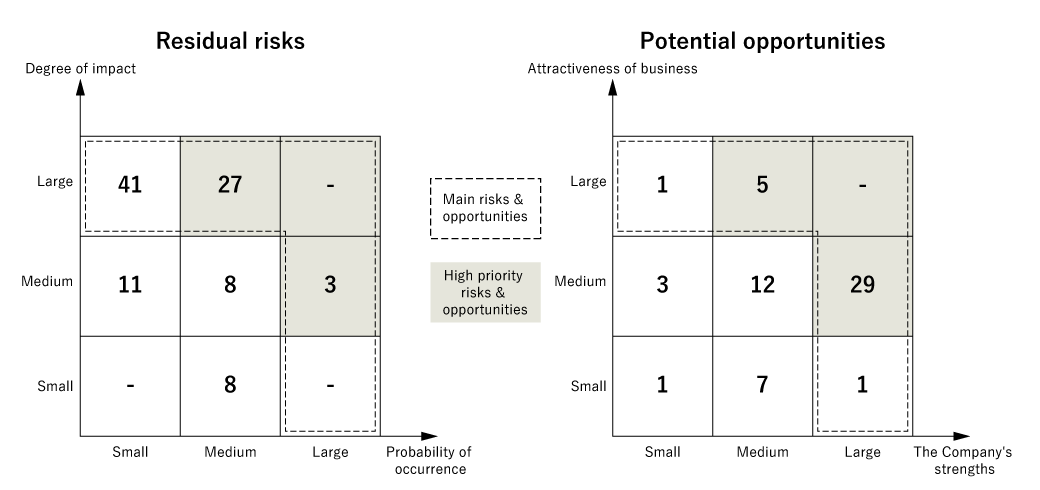
In addition, we attempted to quantify the financial impacts of eight of the above risks and 11 of the opportunities listed in the table below. This includes those that cannot be quantified at this time and those for which quantification has not yet been completed.
Among the remaining risks, for example, in the Timber and Building Materials Business, under the scenario of manufacturing sites shutting down due to increased risk of inland flooding caused by climate change, the financial impact of "reduced sales and increased recovery costs due to the shutdown of four direct operation sites" was indicated as significant.
Among the potential opportunities that could materialize, for example, in the same Timber and Building Materials Business, under a scenario where wood use is promoted as a policy around the world as a means to achieve carbon neutrality and nature positive, the financial impact of "increased sales from new product development related to the mass timber market, such as CLT" was deemed significant.
Regarding scenarios, we utilize some of the TCFD scenario analysis for physical risks that has been already conducted, and we plan to conduct a full-scale TNFD scenario analysis in the future.
| Item (risks) | Items for which attempts were made to quantify the financial impacts | Business | Size of impact | Probability of occurrence | |||
|---|---|---|---|---|---|---|---|
| Transition Risks | Policies | Change in raw material procurement | Increase in procurement costs for PKS due to compliance with stricter laws and regulations following the introduction of policies to promote certification | Short to medium term | Environment and Resources (biomass power generation) | Large | Medium |
| Legal responsibilities | Introduction of environmental regulations | Increase in costs due to compliance with stricter laws and regulations in response to the use of timber related to illegal and unsustainable forest harvesting | Short term | Timber and Building Materials (manufacturing and distribution) | |||
| Market | Change in raw material procurement | Increase in costs due to higher fuel costs resulting from increased demand and tougher competition for woody biomass feedstock and PKS | Short to medium term | Environment and Resources (biomass power generation) | |||
| Physical Risks | Acute | Occurrence of disasters | Decrease in sales and increase in restoration costs due to shutdown of operations caused by severe and more frequent flood damage from heavy rain and other factors | Short to long term | Timber and Building Materials (manufacturing) | ||
| Decrease in sales and increase in restoration costs due to suspension of operations following landslide in planted forests near plants | Long term | Timber and Building Materials (manufacturing) | |||||
| Chronic | Occurrence of disasters | Increased costs of insurance premium payments for properties under construction due to increased risk of natural disasters | Short to medium term | Housing (custom-built detached houses), Overseas Housing (detached and subdivision houses) | |||
| Decrease in sales due to construction delays caused by vulnerable construction infrastructure and increased risk of natural disasters resulting from land modification in the surrounding areas | Long term | Overseas Housing (detached and subdivision houses), Real Estate (real estate development) | |||||
| Change in raw material procurement | Increase in procurement costs due to reduced wood supply resulting from disasters and ecological degradation at procurement sites | Long term | Timber and Building Materials (manufacturing) | ||||
| Item (opportunities) | Items for which attempts were made to quantify the financial impacts | Business | Attractiveness of business | The Company’s strengths | |||
|---|---|---|---|---|---|---|---|
| Business performance | Market | Expansion of consulting market | Increase in sales owing to sales of natural symbiosis site consulting service in Japan | Short to medium term | Environment and Resources (company-owned forests in Japan) | Medium | Large |
| Expansion of credit market | Sales increased by promoting the credit market through participation in rulemaking for biodiversity credits | Medium to long term | Environment and Resources (company-owned forests in Japan and overseas forest management) | ||||
| Change in wood product market | Increase in sales owing to new product development such as biorefinery, CLT or reuse of waste materials, etc. | Medium to long term | Timber and Building Materials (manufacturing) | ||||
| Products and services | Change in wood product market | Increase in sales owing to sales of forest management technologies such as remote sensing, drone surveys, satellite applications, etc. | Short to medium term | Environment and Resources (company-owned forests in Japan and overseas forest management) | |||
| Spread of NbS | Increase in sales from the provision of industrial tourism and eco-tourism products | Medium to long term | Environment and Resources (company-owned forests in Japan) | Large | Medium | ||
| Increase in sales due to payments for ecosystem services (PES) made by companies and local governments (specifically for public benefits provided by forests) | Short to long term | Environment and Resources (company-owned forests in Japan and overseas forest management) | |||||
| Resource efficiency | Shift to efficient use of resources | Reduction of water procurement costs through further water conservation in manufacturing processes and reduced and more efficient water use | Medium to long term | Timber and Building Materials (manufacturing) | Medium | Large | |
| Decrease in costs due to conversion from natural wood to wood from planted forests | Medium to long term | Timber and Building Materials (manufacturing) | |||||
| Decrease in costs through promotion of efficient construction methods (panelization and trussing) during construction | Medium to long term | Real Estate (real estate development) | |||||
| Industrial waste disposal costs reduced by promoting the conversion of incineration ash into valuable resources | Short term | Environment and Resources (biomass power generation) | |||||
| Reputation | Spread of green infrastructure | Increase in sales owing to the acquisition of new customers who value the natural environment following the enhancement of natural symbiotic functions (greening, water retention/permeable pavement, biodiversity initiatives, etc.) within housing and construction sites | Medium to long term | Overseas Housing (detached and subdivision houses), Real Estate(real estate development) and Housing (custom-built detached houses) | |||
*All risks and opportunities at direct operation locations are quantified and shaded
*Short-term: from the end of 2023 to 2024 ("Mission TREEING 2030 Phase 1"), medium-term: from 2025 to 2030 ("Mission TREEING 2030 Phase 2" and beyond), and long-term: from 2031 to 2050
Sumitomo Forestry's Measures (“Prepare”)
In our analysis based on TNFD's LEAP approach, we utilized the TCFD scenario analysis performed for physical risks. To promote businesses that contribute to a nature positive world under the medium-term management plan "Mission TREEING 2030 Phase 2 (2025 -2027),” we are implementing TNFD scenario analysis and setting targets in a step-by-step manner by utilizing quantitative assessments including LIME3, which is a life cycle impact assessment method.
Currently, as a preparatory step for target setting, we are designing pilot projects aimed at quantifying and monitoring the specific impacts of our business activities on nature, excluding indicators such as water which we have already quantitatively assessed and set targets for. Specifically, we are promoting projects, such as forest biodiversity and water resource surveys. We will utilize the results of these surveys when setting targets for the next medium-term management plan, while disclosing the results to the public by reporting them through conference presentation and other means as appropriate. Furthermore, in accordance with TNFD guidance, we will proceed with considering the formulation of a nature transition plan.
Key measures to address the identified priority risks and opportunities include the following.
| Risks & opportunities | Proposed measures | ||
|---|---|---|---|
| Timber and Building Materials Business (Manufacturing) | Risks | Decrease in sales and increase in restoration costs due to shutdown of operations at SRP, ASTI, RPI, and VECO, four sites at high risk of internal flooding as a result of severe flooding from heavy rains, etc. | Consider flood risk when selecting sites for operations and enhance disaster prevention measures Establish a business continuity plan (BCP) in the event of a major disaster and establish a rapid recovery system |
| Overseas Housing Business (FITP) | Opportunities | Increase in sales and decrease in costs owing to development of new products that reuse waste materials and development of technologies for more efficient use of resources, etc. | Promote the development of products that make effective use of resources in cooperation with the recycling industry to differentiate products in the market |
| Environment and Resources Business (Company-owned forests in Japan, and overseas forest management) | Opportunities | Increase in sales owing to sales of smart forest technologies such as remote sensing, drone surveys, satellite applications, etc. | Develop a service package that supports accurate understanding of forest health and resource quantity by utilizing the latest remote sensing, drone survey, and satellite technologies, and propose to improve the efficiency and accuracy of forest management Deploy marketing activities for service packages targeting local governments and companies that own large forests |
| Environment and Resources Business (Biomass Power Generation) | Risks | Increase in costs due to higher fuel costs at Mombetsu Biomass Electric Power Plant and Hachinohe Biomass Electric Power Plant, following increased demand and intensified competition for unused wood chips and imported PKS | Diversify raw material procurement by developing alternative fuels and new sources of supply Utilize long-term and forward contracts to manage the risk of fuel cost volatility |
Comment from experts
The Sumitomo Forestry Group reported to and obtained advice from external stakeholder experts on the narrowing-down process in the “Locate” and “Evaluate” phases of the TNFD LEAP analysis conducted from December 2023 to February 2024.
■Mutai Hashimoto, Lead, Sustainable Finance, WWF Japan
For many years, Sumitomo Forestry has implemented a procurement policy aimed at avoiding negative impacts on nature in wood procurement, and its disclosures are in line with SBT for Nature's recommended framework for actions to achieve a nature positive world (AR3T). Although many of the nature-related opportunities listed have a clear business connection at this point in time, it is expected that the restoration of nature itself will be regarded as a nature-positive opportunity more broadly, and that these opportunities will be linked to business opportunities in the future.
■Makino Yamanoshita, Joint Programme Director, Biodiversity & Forests, Institute for Global Environmental Strategies
While it is scientifically recognized that climate change measures and the conservation of biodiversity and ecosystem services are interdependent, I found it very interesting that Sumitomo Forestry has accumulated nature-related information and on-the-ground experience in its overseas forest management operations and other activities, which are not represented in the database or other materials provided by the TNFD. I believe that the company can become truly nature positive by utilizing such information and experience for its future analyses based on TNFD’s LEAP approach and related measures.

- Home
- Sustainability
- Environment
- Analysis Based on TNFD’s LEAP Approach